


 1300 164 990
12 Different Types of Lenses for Glasses
Updated on June 25, 2026
Published on May 30th, 2023
 Australia
Lenses for glasses are pieces of material placed inside a glasses frame to provide the wearer with clear vision and protect the eyes. Lenses are usually glass or plastic and can be prescription or non-prescription. Eyeglass lenses are used for vision correction, most commonly for refractive errors such as myopia (nearsightedness), hyperopia (farsightedness), presbyopia, and astigmatism. This article will cover 12 types of lenses, from vision correction lenses to specialty coatings.
- Single Vision Lenses: Single vision lenses have one prescription power across the entire lens and are used to correct one refractive error, such as myopia, hyperopia, or astigmatism.
- Bifocal Lenses: Bifocal lenses have two distinct optical zones — distance on top and near at the bottom — separated by a visible line.
- Trifocal Lenses: Trifocal lenses contain three distinct zones: distance, intermediate, and near, with two visible dividing lines.
- Progressive (Multifocal) Lenses: Progressive lenses contain three different prescriptions for near, intermediate, and distance vision with no visible lines.
- Photochromic Lenses: Photochromic lenses darken automatically in response to UV light and are a pair of optical glasses and sunglasses in one.
- Blue Light Filtering Lenses: Blue light filtering lenses are designed to filter artificial blue light rays emitted by digital screens.
- Polarised Lenses: Polarised lenses reduce glare and can additionally reduce eye strain in high-glare environments.
- Prism Lenses: Prism lenses refract light to ensure it enters the eye properly, and are used to treat double vision and other binocular vision issues.
- High Index Lenses: High index lenses are lighter and thinner than standard lenses and are ideal for high prescriptions.
- Aspheric Lenses: Aspheric lenses have less curvature than traditional spherical lenses, making them flatter, thinner, and lighter.
- Polycarbonate Lenses: Polycarbonate lenses are thin, lightweight, and highly impact-resistant with built-in UV protection.
- Occupational (Computer) Lenses: Occupational lenses are designed to support office workers and other professionals with close-up work and reduce neck strain.
1. Single Vision Lenses
Single vision lenses have one prescription power across the entire lens. Glasses with single vision lenses are prescribed by an optometrist to correct refractive errors, including myopia, hyperopia, presbyopia, and astigmatism, by ensuring that light is refracted onto the retina properly. Single vision lenses that correct near vision are also known as reading glasses and make tasks such as reading or knitting easier. The lenses used in single vision glasses are typically either convex or concave, depending on the refractive errors being corrected. Single vision lenses are ideal for people who only need one form of vision correction, whether that be for near or distance vision. For those who need correction for both near and far distances, multifocal lenses are an ideal choice.
2. Bifocal Lenses
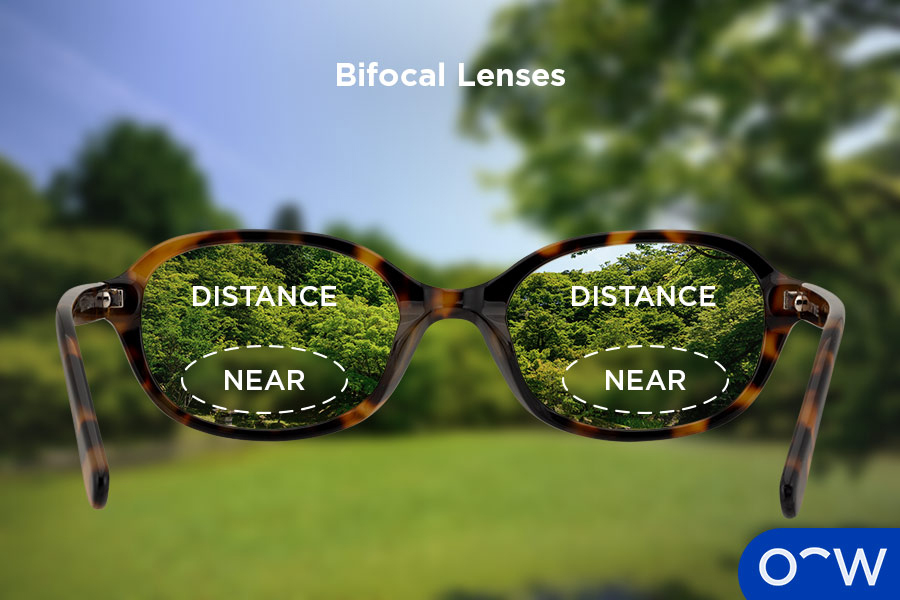
Bifocal lenses have two distinct optical zones: distance on top, and near at the bottom, separated by a visible line. Bifocal lenses can help those with myopia, hyperopia, and astigmatism. These lenses are designed for people who need to see both close-up and far away without swapping glasses. Bifocal lenses are commonly prescribed to adults over 40 who develop presbyopia, a condition where the lens loses flexibility, making it hard to focus on near objects. These lenses can also be used for children and young adults to correct focusing strain, according to the Optometrists Network.
3. Trifocal Lenses
Trifocal lenses contain three distinct zones: distance, intermediate, and near, with two visible dividing lines. Trifocal lenses are often used in glasses to correct presbyopia in those over 40, according to Healthline. Trifocal lenses are helpful for people who experience blurry vision at three distances: close-up, far away, and in between. Multifocal, or progressive lenses, are often more desirable for patients in this case, as there is a gentler, seamless transition between the zones without a visible line. Oscar Wylee does not sell trifocal lenses.
4. Progressive (Multifocal) Lenses
Multifocal lenses contain three different prescriptions for near, intermediate, and distance vision correction. Multifocals have a no-line seamless transition between the three prescriptions, making for uninterrupted vision. Multifocal lenses, also known as progressive lenses, are typically offered in three different levels: standard, premium, and elite. A multifocal standard lens will offer clear vision for all three distances but may include apparent areas of soft focus at the edges of the lens. A multifocal premium lens offers a wider range of clear vision with moderate areas of soft focus at the edges of a person's vision. Finally, a multifocal elite lens is the highest quality of multifocals and offers very minimal areas of soft focus, and is the easiest to adapt to. Multifocal lenses may be preferred to bifocal and trifocal lenses, as they cover all three vision zones with no visible lines. Patients may experience some peripheral distortion during the adaptation period, which is common.
5. Photochromic Lenses
Photochromic lenses are a type of transition or adaptive lens with a chemical coating that causes the lenses to darken in response to contact with ultraviolet rays emitted from the sun. These lenses will even darken on cloudy or rainy days as the reaction is still active. However, the level of darkness will depend on how much UV light is present. Photochromic lenses are a pair of optical glasses and sunglasses in one, perfect for people who need vision correction in their sunnies and for those who frequently change between outdoor and indoor environments. Photochromic lenses offer clear and comfortable vision as well as UV protection. Oscar Wylee offers our own brand of Transition lenses (photochromic lenses) as well as branded Transitions® GEN S™ lenses. Oscar Wylee's own brand of Adaptive lenses is available for an additional $100 on top of your prescription frames, and Transitions® GEN S™ lenses are available for an additional $160 on top of the price of your prescription frames. Transitions® GEN S™ lenses adapt quickly to your changing light conditions in 25 seconds1, with a fast fade-back2 from dark to clear lenses and provide a high-quality visual experience.
Transitions is a registered trademark and the Transitions logo is a trademark of Transitions Optical, Inc., used under license by Transitions Optical Ltd. GEN S is a trademark of Transitions Optical Limited. ©2025 Transitions Optical Limited. Photochromic performance may vary across colours and lens materials and is influenced by temperature and UV exposure.
1For CR39 lenses across colours, achieving 18% transmission at 23°C.
2For grey CR39 lenses with a premium anti-reflective coating fading back to 70% transmission @ 23°C.

6. Blue Light Filtering Lenses
Blue light filtering lenses are designed to filter artificial blue light rays emitted by digital screens. Blue light filter lenses work by reducing the amount of blue light that enters the eye due to a special coating on the lens, which either absorbs or reflects blue light. These types of lenses are often used by people who spend much of their time working on a computer for school, work, or gaming, as artificial light is emitted from digital screens. A blue light filter is a popular choice to help enhance everyday visual comfort when using digital devices, providing glare reduction and contrast enhancement. Oscar Wylee offers a BLULite Filter for an additional $85 and a BLULite Filter Premium for an additional $95.
7. Polarised Lenses
Polarised lenses are a type of lens that reduces glare. Polarisation can either be built into the lens material or applied as a coating over the lens. Polarised lenses work by cutting out the amount of horizontal light that enters the lens and hits the eye, which can additionally reduce eye strain and improve sight in high-glare environments, such as when driving or when fishing. While polarised lenses' main function is to reduce glare, they can also offer UV protection, as most retailers will add UV protection to polarised sunglasses or lenses. However, this may not always be true, so it is best to check whether polarised lenses contain UV protection. At Oscar Wylee, all of our polarised glasses have UV protection. While standard non-polarised sunglasses are included in our base pricing, selecting a polarised lens option is available as an upgrade for an additional $100 per pair.

8. Prism Lenses
Prism lenses are a type of lens that refracts light to ensure it enters the eye properly. These types of lenses are prescribed to treat vision conditions, including double vision (diplopia), as well as other binocular vision issues. Prism lenses help with double vision by ensuring your eyes have matching light refraction, which eliminates the possibility of your brain perceiving images as double. Prism lenses correct double vision by changing the direction of light towards the retina. Typically, the brain can transform the objects seen by each eye into one image. Oscar Wylee offers prism lenses at no extra cost to a pair of glasses with our standard lenses.
9. High Index Lenses
High index lenses are a type of lens that is lighter and thinner than standard lenses and is ideal for high prescriptions. Oscar Wylee offers high index lenses in a 1.61 index, 1.67 index, and 1.74 index. 1.61 index lenses are recommended for prescriptions up to +/- 3 diopters, 1.67 index lenses are recommended for prescriptions up to +/- 4 diopters, and 1.74 index lenses are ideal for all prescriptions but are recommended for those with +/-4 diopters and above. High index lenses are beneficial as they are lighter and thinner than standard lenses, offer clearer and sharper vision as light has less area to travel through, and are often chosen for their aesthetics as they reduce the magnification and minification of the eyes. High index lenses are available for most types of lenses, including multifocals, bifocals, and single vision lenses.
10. Aspheric Lenses
Aspheric lenses are not a perfect sphere or cylindrical lens and have less curvature than a traditional spherical lens. Aspheric lenses are also flatter than regular eyeglass lenses, and therefore thinner and lighter. These lenses keep all light rays focused on the same point, unlike traditional lenses that cause light to bend more or less than light passing through the centre. Aspheric lenses are recommended for individuals with strong prescriptions, who wear reading glasses, and patients undergoing cataract surgery. At Oscar Wylee, our higher-index options (such as 1.67 and 1.74) utilise an aspheric design to keep your glasses as thin and flat as possible.
11. Polycarbonate Lenses
Polycarbonate lenses are thin, lightweight lenses made from a highly impact-resistant thermoplastic with built-in UV protection. Polycarbonate lenses were originally made for aerospace use, but are now used for safety glasses, sports goggles, and children's eyewear due to their durability. These lenses are a great choice for their impact resistance, lightweight feel, and UV protection; however, they may scratch more easily and can be more expensive than traditional lenses. Oscar Wylee does not sell polycarbonate lenses; however, our children's frames include a complimentary material called Hivex, which is similar.
12. Occupational (Computer) Lenses
Occupational, or computer lenses, are designed to support office workers and other professionals with close-up work. Occupational lenses allow you to see your screen without head tilting or neck strain. These lenses allow for seamless transitions between near and intermediate vision, such as reading a paper to viewing a computer screen, and contain a larger viewing area than progressive lenses. Occupational lenses are an ideal choice for office workers who wish to improve comfort and ease of viewing at work.
While Oscar Wylee does not offer a standalone traditional 'occupational lens' category, our Premium Multifocal range features a dedicated 'Office Progressive’ option. This is tailored specifically for intermediate and near-distance tasks, making it ideal for desk and computer work.
How do Single Vision Lenses Compare with Progressive Lenses?
| Feature | Single Vision | Progressive (Multifocal) |
|---|---|---|
| Focal Range | One distance only (Near, Mid, or Far). | All distances (Near, Mid, and Far). |
| Lens Design | Uniform prescription; no lines or distortion. | Gradient prescription; no lines, slight edge blur. |
| Adaptation | Instant. | Moderate (days to weeks). |
| Daily Use | Look anywhere through the lens; you may need multiple pairs. | Look through specific zones; one "do-it-all" pair. |
What are the Differences between Bifocal Lenses and Progressive Lenses?
| Feature | Bifocal | Progressive (Multifocal) |
|---|---|---|
| Structure | Two distinct zones (Far and Near only). | Continuous gradient (Far, Mid, and Near). |
| Mid-Distance | None (poor for computer screens). | Dedicated intermediate corridor. |
| Transition | Abrupt "image jump" across a visible line. | Seamless, smooth change with no lines. |
| Appearance | Has a visible line. | Looks like a standard, line-free lens. |
Which Lenses Correct Distance Vision?
The lenses most commonly used to correct distance vision include single vision lenses, progressive lenses, bifocal lenses, and trifocal lenses. These lenses that correct distance vision are explained below.
- Single vision lenses: Single vision lenses contain one consistent power across the entire lens and are the go-to choice for myopia patients.
- Progressive lenses: Progressive, or multifocal lenses, integrate multiple prescriptions into one lens.
- Bifocal lenses: Bifocal lenses feature a distinct line that separates distance and near-vision correction.
- Trifocal lenses: Trifocal lenses include three visible zones for distance, intermediate, and close-up vision.
Which Lenses Correct Near Vision?
The lenses most commonly used to correct near vision include single vision reading glasses, progressive lenses, bifocal lenses, and trifocal lenses. These lenses that correct near vision are explained below.
- Single vision reading glasses: Single vision reading glasses are a good choice if you only need correction for close-up reading tasks.
- Progressive lenses: Progressive, or multifocal lenses, integrate multiple prescriptions into one lens and are the most popular option for near vision correction.
- Bifocal lenses: Bifocal lenses feature a distinct line that separates distance and near-vision correction.
- Trifocal lenses: Trifocal lenses include three visible zones for distance, intermediate, and close-up vision.
Do Bifocal Lenses Provide Simpler Adaptation than Progressive Lenses?
Yes, bifocal lenses provide simpler adaptation than progressive lenses. Bifocal lenses only feature two distinct zones separated by a visible line, and this allows wearers to adapt quickly within a few days. Progressive lenses may have a longer adaptation period because the brain needs to learn how to navigate shifting prescriptions.
What are the Different Lens Materials for Glasses?
The different lens materials for glasses are plastic, polycarbonate, Trivex, high index, and glass. These materials for glasses are explained below.
- Plastic: Plastic is a lightweight, affordable material great for everyday use and commonly used to make lenses.
- Polycarbonate: Polycarbonate is a highly durable material that is thinner and lighter than plastic, ideal for children, sports, and safety eyewear.
- Trivex: Trivex offers strong impact resistance and is more lightweight than polycarbonate. Trivex blocks 100% of UV rays. Oscar Wylee does not sell Trivex frames.
- High index: High index lenses are significantly thin and light, and are ideal for strong prescriptions.
- Glass: Glass allows for exceptional clarity, but can be heavier and prone to shattering.
Which Lens Material is the Most Lightweight?
The most lightweight lens material is between Trivex and high-index 1.74 materials, with the lightest option depending on the prescription strength. Trivex is ideal for low-to-mid prescriptions, offering the best weight-to-clarity ratio; however, 1.74 high index lenses are the best choice for strong prescription glasses.
What are the Types of Lens Coatings Available for Glasses?
The types of lens coatings available for glasses can include anti-reflective (AR), scratch-resistant, UV protection, blue light filtering, photochromic, polarised, and mirror coatings. The types of popular lens coatings available for glasses are explained below.
- Anti-reflective (AR): Anti-reflective (AR) coatings eliminate glare and are an essential coating for glasses.
- Scratch-resistant: Scratch-resistant coatings help prevent surface damage, extending the lifespan of your glasses.
- UV protection: UV protection coatings protect your eyes from harmful UV rays, which is important for your eye health. All Oscar Wylee glasses come with UV400 protection, which blocks 100% of UVA and UVB rays.
- Blue light filtering: Blue light filtering coatings reduce the amount of blue light that enters the eye, which may help reduce digital eye strain.
- Photochromic: Photochromic coatings allow glasses to automatically darken in bright environments and become clear indoors.
- Polarised: Polarised coatings are designed for sunglasses to reduce glare and provide superior visual comfort for outdoor activities.
- Mirror: Mirror coatings are a reflective layer applied to sunglasses that prevents excess light from entering the eye, as well as adding a trendy reflective style.
How Much Do Different Types of Eyeglass Lenses Cost?
The cost of different types of eyeglass lenses can range from $80 to $700, depending heavily on the type of vision correction needed, the lens material, add-on coatings, and the chosen retailer. At Oscar Wylee, a pair of optical glasses with standard single vision lenses starts at $169.
What Factors Affect the Price of Prescription Lenses?
The factors that affect the price of prescription lenses are your prescription strength, the lens material, additional specialised coatings, the type of vision correction needed, and the chosen retailer. These factors that affect the price of prescription lenses are explained below.
- Prescription strength: Prescription strength is a major factor in the price of prescription lenses, as high prescriptions often require more complex lens designs and thinner lens materials.
- Lens material: Lens material will affect the price of prescription glasses, with plastic being the most affordable and thinner, more lightweight options, such as high index, polycarbonate, and Trivex being more expensive.
- Specialised coatings: Specialised coatings and add-ons used to customise your glasses, including blue light filters and photochromic coatings, usually incur additional prices.
- Vision correction: Vision correction can affect the price of prescription lenses, with bifocals, trifocals, and multifocal lenses often costing extra.
- Retailer: The retailer you choose to purchase your prescription lenses will greatly affect the price. At Oscar Wylee, we pride ourselves on delivering high-quality glasses at affordable prices.
Are Progressive Lenses More Expensive than Bifocal Lenses?
Yes, progressive lenses are typically more expensive than bifocal lenses. Progressive lenses are more expensive than bifocal lenses because of increased manufacturing costs due to the seamless gradient power of the lenses.
How to Choose the Right Eyeglass Lenses?
To choose the types of lenses for glasses that are right for you, you should listen to the advice of the optometrist and retail staff, consider your lifestyle needs, and understand the different types of lenses on offer. These steps are explained further below.
- Listen to the advice of the optometrist and retail staff: Listen to the advice of the optometrist and retail staff, as they can advise you best. If you have an eye test in-store, the optometrist will pass your prescription along to the retail staff, who will recommend a type of lens for your glasses. The retail staff member will also talk you through the different lens options available.
- Consider your lifestyle needs: Consider your lifestyle needs and what you need your lenses to do. For example, if you spend lots of time working on a computer or other screens, you may want to add a blue light filter to your glasses lenses. Or if you need vision correction and also want a pair of sunglasses, you can try photochromic lenses.
- Understand the different types of lenses on offer: Understand the different types of lenses on offer, so you know what your options are. You can do your own research or ask the retail staff, who will be happy to help.
What are the Best Lens Types for Reading Glasses?
The best lens types for reading glasses may include single vision, multifocal (progressive), or bifocal lenses, ideally with anti-reflective coatings, blue light filters, and scratch-resistant coatings, but ultimately depend on your lifestyle.
What Lens Options are Best for Everyday Use?
The lens options best for everyday use may include single vision, multifocal (progressive), photochromic, and blue light lenses, but ultimately depend on your lifestyle.
What Lens Types does Oscar Wylee Offer?
At Oscar Wylee, we offer single vision distance, single vision near, single vision intermediate, multifocal, and non-prescription lenses. The lens types we offer are explained below.
- SVD (Single Vision Distance): SVD lenses are used for far distances like driving, watching TV, or walking around.
- SVN (Single Vision Near): SVN lenses are used for close vision, such as reading books or writing.
- SVI (Single Vision Intermediate) (Only available to order in store): SVI lenses provide clarity around 1m away. SVI lenses are great for activities such as computer use or reading sheet music.
- Progressive (Multifocal) (Only available to order in store): Progressive lenses, also known as multifocal lenses, allow for viewing multiple focal lengths, with multiple prescriptions inside the lens. Multifocal lenses can assist with distance viewing (like driving or TV), medium-range (computer distance), and near viewing (reading books or a phone).
- Non-prescription: Non-prescription lenses are lenses with no prescription. These glasses are mainly worn for aesthetic purposes, or for a specific purpose if they have a filter, such as a blue light filter.
You can view our price guide for more information about lens types we offer, including sunglass options, coatings, and add-ons.
Does Oscar Wylee Offer Multifocal Lenses?
Yes, Oscar Wylee offers three types of multifocal lenses: Multifocal Standard, Multifocal Premium, and Multifocal Elite. Our Multifocal Standard lenses have some degree of soft focus at the edge of a person's vision, are good for occasional glasses use, and are ideal for those on a budget. The Multifocal Premium offers a wider field of clear vision, is ideal for those who wear glasses in the office for computer work, and is easier to adjust to compared to standard multifocal lenses. Multifocal Elite lenses offer a very wide field of clear vision, are an all-rounder lens for modern lifestyle demands and a lot of computer work, and provide more comfortable and natural vision.

Does Oscar Wylee Offer Reading Glasses?
Yes, Oscar Wylee offers reading glasses, which are single vision lenses that correct a person's near vision. The lenses in reading glasses act as a magnifying glass, by enlarging objects close to your eyes when reading or doing other close-up activities such as writing or knitting. Reading glasses can be used for people who have presbyopia. Presbyopia is an age-related eye condition that commonly affects people over the age of 40, as it is caused by the natural ageing process, which disrupts the lens, causing blurry close-up vision.
Does Oscar Wylee Provide High-Index (Thinner and Lighter) Lenses?
Yes, Oscar Wylee provides three levels of high-index lenses: a 1.61 thin index lens, a 1.67 thinner index lens, and the 1.74 thinnest index lens. The 1.61 index lens is lighter and thinner than our standard 1.5 index lens and is recommended for prescriptions up to +/- 3 diopters. The 1.67 index lens is recommended for prescriptions up to +/- 4 diopters. Our thinnest lens, 1.74 index, is ideal for all prescriptions but is recommended for those with +/-4 diopters and above.
Prices and product availability are current as of June 2026 and are subject to change. Standard single-vision prescription glasses start from $169, which includes frames and standard 1.5 index single-vision lenses. Additional lens options, specialised coatings, and index upgrades incur extra charges. Eye test eligibility for Medicare bulk-billing is subject to Medicare guidelines and individual eligibility criteria.
Read 8 Different Types of Lenses for Glasses in other Oscar Wylee regions and their languages.
Australia