


 1300 164 990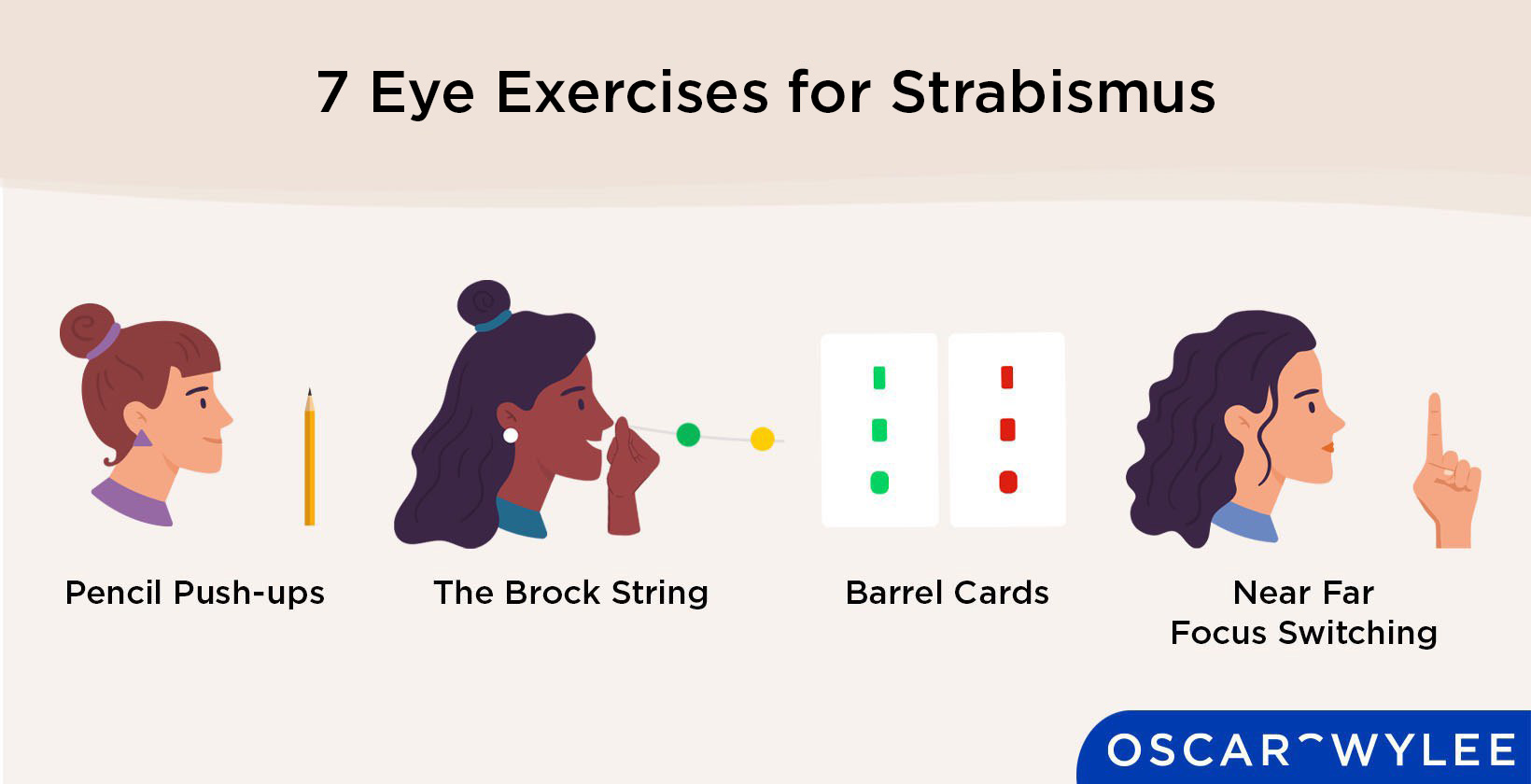

7 Eye Exercises for Strabismus
Updated on June 16, 2026
Published on August 30th, 2023
 Australia
Strabismus, also known as misaligned eyes or crossed eyes, is an eye condition where the eyes are not in alignment with each other, with one eye turned in a different direction. Strabismus is caused by eye muscle problems and can occur due to medical conditions, refractive errors, or genetic factors. Strabismus commonly affects children, but can also occur in adults. Strabismus treatment includes surgery, glasses, and vision therapy involving eye exercises. Eye exercises for strabismus may not fix crossed eyes naturally, but may improve the condition by strengthening eye muscles. Several eye exercises may be used in the treatment of certain types of strabismus, including pencil push-ups, the Brock string, barrel cards, near-far focus switching, figure eight eye tracking, convergence dot card exercise and computer-based vision therapy exercise. The exact effectiveness of eye exercises for strabismus will depend on the individual. It is important to consult an eye care professional or healthcare provider before starting any eye exercises, as they may not be effective for everyone. Eye exercises should not be performed as an alternative to getting an eye test or seeing an eye care professional for treatment. The types of eye exercises for certain types of strabismus are listed below.
- Pencil Push-Ups: Pencil push-ups are an eye exercise used to treat certain types of strabismus, as it trains the eyes to converge on a single point.
- The Brock String: The Brock string is an eye exercise used in vision therapy to improve certain types of strabismus, as it helps the eyes work together and coordinate.
- Barrel Cards: Barrel cards are an eye exercise that aims to improve how the eyes converge and see a single close-up object, which may be beneficial for those with certain types of strabismus.
- Near-Far Focus Switching: Near-far focus switching involves switching focus between a near and a far object to help strengthen the eye muscles, which may be beneficial for those with certain types of strabismus.
- Figure Eight Eye Tracking: Figure eight eye tracking is a vision therapy technique that aims to improve eye muscle flexibility and coordination.
- Convergence Dot Card Exercise: The convergence dot card exercise is a visual therapy technique designed to improve eye alignment and a patient's ability to cross their eyes.
- Computer Based Vision Therapy Exercises: Computer based vision therapy involves special interactive software that helps patients with strabismus by improving eye coordination.
1. Pencil Push-Ups
Pencil push-ups are a type of eye tracking exercise that can be used to help treat certain types of strabismus, as they can help train the eyes to focus on a single point. Pencil push-ups are a type of eye exercise used to train the eyes to converge on a single point or object close up. Pencil push-ups are conducted by holding a pencil at arm's length away from the face, with the top of the pencil at eye level, according to the Royal Devon University Healthcare NHS Foundation Trust. The arm then moves towards the face, with the eyes focusing on the top of the pencil, trying to keep the pencil as one image. If the pencil becomes two images, the participant should stop and focus until it becomes one. This should be conducted for 30 seconds, 3 times a day. Tromboning exercises are also similar to pencil push-ups; however, they use a finger, not a pencil. Pencil push-ups can be done at home, without an optometrist or healthcare professional.

2. The Brock String
The Brock string is an eye exercise that may be used as part of vision therapy in the treatment of certain types of strabismus, as it can help the eyes work together and coordinate when looking at a nearby object. A brock string is commonly a white string that has three beads, coloured red, yellow and green, placed along the length. One end of the string is held up to the patient's nose, whilst the other is held by another person, and the beads are placed at different points on the string which the patient needs to look at, according to Eyecare Kids Australia. A person will see two strings in the shape of an X as well as one image of the bead if they have vision without strabismus, according to Medical News Today. For those who have strabismus, there may be two images of the bead, in which case, the bead should be moved back until there is just one image. The aim is to be able to move the bead closer to the eye without the image of the bead separating into two images. The Brock string eye exercise can be done at home, without an optometrist or healthcare professional present.

3. Barrel Cards
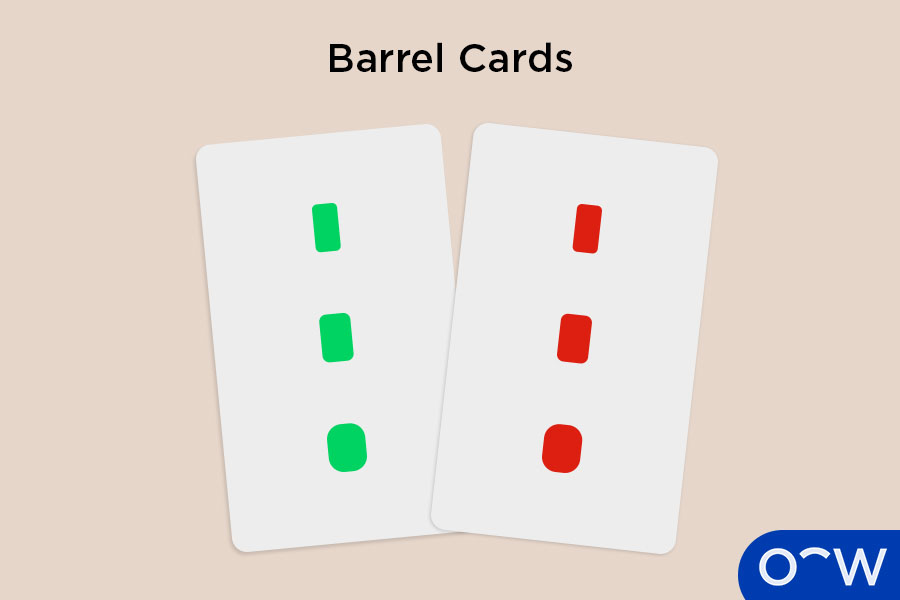
Barrel cards are a type of eye exercise that can be used to help treat certain types of strabismus, as they can help train the eyes to converge, or focus on the same object together. Barrel cards are cards with three barrel shapes drawn on one side in red, which increase in size. On the other side of a barrel card, there will be three barrel shapes increasing in size again, but in green. Barrel card eye exercises work by holding the card up to the nose so the largest barrel is furthest away, according to Medical News Today. The patient will then focus the eyes on the barrel furthest away until the colours converge and the remaining two barrels have doubled. This should then be repeated with the middle barrel and the barrel closest to the eye.
4. Near-Far Focus Switching
Near-far focus switching is a type of eye exercise that can help treat certain types of strabismus, as it helps to strengthen the eye muscles and can help train the eyes to focus. Near and far focus switching works by holding a finger at arm's length, looking at the finger and then switching the gaze to something far away. The gaze is then brought back to the finger. Near-far focus switching can help strengthen the eye muscles, help a patient control their eyes better, and help train the eyes to work in coordination, all skills that can be beneficial for strabismus. Near-far focus switching can be conducted at home, without an optometrist or healthcare professional present.

5. Figure Eight Eye Tracking
Figure eight eye tracking is a vision therapy technique that aims to improve eye muscle flexibility and coordination. To perform figure eight eye tracking, sit comfortably with your feet flat on the floor, pick a spot about 3 metres away, and use your eyes to trace an imaginary figure eight on the spot. Once begun, keep tracing for 30 seconds, then change the spot and repeat the exercise. Figure eight eye tracking can help to stretch and improve flexibility in the extraocular muscles, as well as assist with poor ocular motility (eye tracking).
6. Convergence Dot Card Exercise
The convergence dot card exercise is a visual therapy technique designed to improve eye alignment and strengthen a patient's ability to cross their eyes. To perform the exercise, you will need to use special cards called convergence cards, which you can purchase through several vision therapy and medical supply stores. Using the cards, start by holding the dot card lengthwise against your nose, angled down so you can see all the dots. After this, look at the furthest dot on the card. You will have to gently move your eyes together inwards so that the dot appears clearly. Once this dot is focused, continue focusing and count slowly to 5. Following this, move your focus to the next closest dot, and repeat the exercise. Continue this routine as you move slowly up the card, until you reach the dot closest to your nose. The convergence dot card exercise is beneficial for strabismus patients as it helps to train the eyes to work together.
7. Computer Based Vision Therapy Exercises
Computer based vision therapy exercises are special interactive software and games that help patients with strabismus by improving eye coordination, convergence (crossing eyes), and depth perception. Websites such as Amblyoplay and Bynocs provide interactive vision therapy exercises for users.
What is Strabismus?
Strabismus, also known as crossed eyes or misaligned eyes, is an eye condition in which the eyes are not in alignment with each other. If you have any sudden change to your eye alignment, see an eye care professional, as sudden strabismus could be implicated with serious conditions like strokes, brain tumours and brain aneurysms. Strabismus is categorised by what way the eye turns. For example, if a person has esotropia strabismus, the eyes are inward turning. If a person has hypertropia, the eye is upward turning. The other two types of strabismus are exotropia, outward turning and hypotropia, downward turning. Strabismus is caused by an issue with the muscles in the eye, which can be due to medical conditions or refractive errors, according to the American Optometric Association. Those with a family history of strabismus may also be at a higher risk of developing the eye condition. Strabismus is one of the most common childhood eye conditions; however, strabismus can also occur in adults, according to the Boston Children's Hospital. Treatment for strabismus can include surgery, glasses or vision therapy, which includes eye exercises. Eye exercises for strabismus, such as pencil push-ups, aim to help the eyes work together in coordination and strengthen the muscles in the eye. Eye exercises should not be performed as an alternative to getting an eye test or seeing an eye care professional for treatment.

Why Does Strabismus Affect Eye Alignment?
Strabismus affects eye alignment due to the brain, muscles and nerves that coordinate eye movement not working correctly, according to the Cleveland Clinic. This leads to one eye deviating one way, while the other focuses elsewhere.
How do Eye Exercises for Strabismus Work?
Eye exercises for strabismus work by strengthening the extraocular muscles in the eyes and retraining the brain to use the eyes together, according to the Vision Eye Institute. Strabismus eye exercises train a patient's visual system to process a single image, which can also treat double vision and depth perception.
Can Eye Exercises Improve Eye Coordination?
Yes, eye exercises can assist in the management or are used as supportive therapy for certain types of strabismus and eye coordination issues. Eye exercises cannot fix refractive errors such as myopia, but they are effective at treating eye conditions such as strabismus. Common eye exercises for strabismus include the Brock String, Pencil Push-Ups, and Figure Eight Eye Tracking. It is important to note that the effectiveness of eye exercises will vary for each individual.
What Other Eye Conditions Benefit from Strabismus Eye Exercise?
The other eye conditions that can benefit from strabismus eye exercises are convergence insufficiency, accommodative dysfunction, binocular vision dysfunction, amblyopia and nystagmus. Read more about these eye conditions that can benefit from strabismus eye exercises below.
1. Convergence Insufficiency
Convergence insufficiency refers to an eye condition in which an individual's eyes struggle to turn, or converge, inward, according to Innovative Eye Care. Pencil push-ups for strabismus can be used for convergence insufficiency, as it trains the eyes to focus on singular points.
2. Accommodative Dysfunction
Accommodative dysfunction is a common eye problem where the eyes struggle to maintain focus between near and distant objects, according to the Australasian College of Behavioural Optometrists. Accommodative dysfunction problems may be alleviated by strabismus eye exercises that target the eye muscles.
3. Binocular Vision Dysfunction
Binocular vision dysfunction refers to when the eyes are not perfectly aligned or coordinated. Strabismus is a type of binocular vision dysfunction, and thus, these eye exercises can benefit those with the condition, according to Westmead Eyes.
4. Amblyopia
Amblyopia, also known as a lazy eye, is an eye condition where one eye develops abnormally, and the brain and the eyes do not work together properly, according to Health Direct. Amblyopia patients may benefit from strabismus eye exercises, as they can help train the brain and the weaker eye to work together.
5. Nystagmus
Nystagmus refers to rapid, involuntary eye movements that cause the eyes to flicker, according to Vision Australia. Nystagmus patients may benefit from strabismus eye tracking exercises, as they can improve visual function, strengthen the eye muscles, and help the brain to coordinate the eyes.
How Effective are Strabismus Eye Exercises?
Eye exercises for strabismus may be an effective way to treat certain types of this eye condition, in a way that is non-invasive. The exact effectiveness of eye exercises for strabismus will be down to the individual and their specific case of strabismus. Eye exercises should not be performed as an alternative to getting an eye test or seeing an eye care professional for treatment.
What Factors Influence the Results of Strabismus Eye Exercises?
The factors that can influence the results of strabismus eye exercises include the severity of the strabismus and the type of strabismus the patient has, according to Micro Prism Vision. Strabismus eye exercises are most effective for strabismus characterised by the eyes' inability to pull together and for intermittent eye drifting types. Exercises are less effective for constant, large-angle, or paralytic strabismus. Strabismus exercises also work better when a patient is consistent in performing the exercises.
Do Exercise Outcomes Depend on the Type of Strabismus?
Yes, eye exercise outcomes are dependent on the type of strabismus you may have. While eye exercises are valuable for training eyes affected by strabismus, they are not a sole cure for the condition.
What is the Success Rate of Strabismus Eye Exercises?
The exact success rate of eye exercises for treating strabismus is unclear, as the effectiveness and success of these eye exercises will depend on each individual and their specific case of strabismus. Eye exercises can be effective in helping to train the eyes to work together and may also be effective in helping strengthen the eye muscles.
What does Research Say About the Success Rate of Strabismus Eye Exercises?
Research says the success rate of vision therapy is 75-87% successful in establishing both functional binocular vision and cosmetic alignment in strabismus patients, according to Cook Vision Therapy.
Can Regular Practice Improve the Chances of Success?
Regular practice of eye exercises for strabismus can strengthen your eye muscles and coordination; however may not eliminate strabismus completely.
What is the Role of Eye Doctors in Choosing a Strabismus Eye Exercise?
An eye doctor, known as an ophthalmologist in Australia, will not commonly play a role in choosing a strabismus eye exercise; this will typically be carried out by an optometrist. In Australia, an eye doctor refers to an ophthalmologist, who is a doctor of medicine with a specialisation in eye care. An ophthalmologist will generally deal with more complex eye conditions such as cataracts and advanced glaucoma. Vision therapy for eye conditions such as strabismus will be directed by an optometrist, specifically a behavioural optometrist, according to the Australasian College of Behavioural Optometrists.
What is the Expected Duration for Strabismus to Improve with Eye Exercises?
The expected duration for strabismus to improve with eye exercises, as part of a vision therapy program, is dependent on the individual and their specific case of strabismus. The duration of a vision therapy program will vary depending on the individual and the severity of their vision issues, but can take anywhere from a few weeks to several months, according to the Optometrists Network. Eye exercises alone may not correct strabismus, but may help as part of a comprehensive vision therapy plan.
Can Eye Exercises for Strabismus Restore Perfect Vision?
No, eye exercises for strabismus will not restore perfect vision, as perfect vision generally refers to visual acuity, something that requires prescription glasses to fix. Strabismus is an eye condition that is caused by issues with the muscles in the eye. Perfect vision refers to good visual acuity, which is how sharp and clear your vision is. Issues with visual acuity are usually treated with prescription glasses to help the eyes see more clearly, as opposed to eye exercises.
Read 7 Eye Exercises for Strabismus in other Oscar Wylee regions and their languages.
Australia