


 1300 164 990

Leber Hereditary Optic Neuropathy (LHON) Disease: Causes and Symptoms
Published on March 9th, 2026
Leber Hereditary Optic Neuropathy (LHON) is a genetic disease that can cause sudden vision loss. Leber Hereditary Neuropathy Disease is caused by genetic mutations in the mitochondrial DNA, according to the Centre for Eye Research Australia. Symptoms of Leber Hereditary Optic Neuropathy start with sudden blurring of vision, usually beginning in one eye. Leber Hereditary Optic Neuropathy affects daily visual function, as central vision is needed for everyday tasks such as reading, driving, and recognising people. There is no definitive cure for Leber Hereditary Optic Neuropathy, and management focuses on helping people with their vision loss. Glasses don’t usually help, improve, or stop vision loss, according to the Mito Foundation. Different kinds of glasses, such as specialised lenses, tints, and low vision aids, can significantly improve visual comfort and function for those with Leber Hereditary Optic Neuropathy by enhancing contrast, reducing glare, and maximising remaining peripheral vision.
What is Leber Hereditary Optic Neuropathy (LHON) Disease?
Leber Hereditary Optic Neuropathy Disease is a rare genetic mitochondrial disease that can cause sudden central vision loss. Mitochondria are the powerhouse of the cell, and when they are not working properly, reduced energy production can lead to the death of retinal ganglion cells, which convey visual information to the brain, according to Retina Australia. Mutations in the MT-ND1, MT-ND4, or MT-ND6 genes can cause Leber Hereditary Optic Neuropathy. Leber Hereditary Optic Neuropathy directly affects the optic nerve and causes it to degenerate, leading to rapid, often permanent, loss of central vision. The disease can affect anyone, but it often appears in young adults, primarily young males, and progresses quickly, according to Dr A. Shemesh’s research article titled ‘Leber Hereditary Optic Neuropathy (LHON)’ in 2024. Potential risk factors include smoking, alcohol use, and exposure to environmental toxins.
How does LHON Affect the Optic Nerve and Central Vision?
Leber Hereditary Optic Neuropathy directly affects the optic nerve fibres, which are responsible for central vision by carrying visual information from the eye to the brain. The optic nerve is composed of the axons of the retinal ganglion cells, which transmit visual signals from the eye to the brain. This signal is damaged in the swollen optic nerve, where retinal ganglion cells are harmed and, as some of these cells die, the optic nerve atrophies, according to the United Mitochondrial Disease Foundation. The atrophied optic nerve reduces the amount of information sent from the brain to the eye and leads to blurred or blind central vision. Most of the time, a person with Leber Hereditary Optic Neuropathy does not go completely blind but will retain their peripheral or ‘side’ vision, according to the Centre for Eye Research Australia.
Is Leber Hereditary Optic Neuropathy Considered a Type of Optic Neuropathy?
Yes, Leber Hereditary Optic Neuropathy is a type of hereditary optic neuropathy. Leber Hereditary Optic Neuropathy is a rare, genetic disease that damages the optic nerve and often leads to selective destruction of the retinal ganglion cells and permanent central vision loss. The condition is a mitochondrial disorder caused by mitochondrial dysfunction. When the retinal ganglion cells die, the optic nerve deteriorates, and information sent from the eye to the brain is diminished, leading to blurred vision or potentially blindness.
Can LHON Cause Colour Vision Deficiency?
Yes, Leber Hereditary Optic Neuropathy commonly causes colour vision deficiency. People with Leber Hereditary Optic Neuropathy often struggle to distinguish red and green early on, and those with a severe case may experience a blue-yellow deficit, according to ophthalmologist Dr. Peter A. Quiros’s study titled ‘Colour vision defects in asymptomatic carriers of the Leber’s hereditary optic neuropathy (LHON) mtDNa 11778 mutation from a large Brazilian LHON pedigree: a case-control study’ in 2006 with over 200 participants. Disruption of colour discrimination is a primary symptom of Leber Hereditary Optic Neuropathy, caused by damage to retinal ganglion cells and their axons, which control central vision pathways.
What Causes Leber Hereditary Optic Neuropathy?
Leber Hereditary Optic Neuropathy is caused by inherited gene mutations in mitochondrial DNA, according to Dr A. Shemesh (2024). Mutations in the MT-ND1, MT-ND4, or MT-ND6 genes can cause Leber Hereditary Optic Neuropathy. Mutations in mitochondrial DNA disrupt cellular energy production and primarily affect the high-energy-dependent optic nerve. Retinal ganglion cells in the optic nerve have a significantly high metabolic activity, being both ‘extremely energy-demanding and fragile neurons’, making them vulnerable to this energy decrease, according to Dr P. Layrolle’s research article titled ‘The Optic Nerve at Stake: Update on Environmental Factors Modulating Expression of Leber’s Hereditary Optic Neuropathy (2024). The death of retinal ganglion cells leads to optic nerve atrophy and, therefore, central vision impairment.
How do Mitochondrial DNA Mutations Lead to Vision Loss in LHON?
Leber Hereditary Optic Neuropathy causes vision loss due to mutations in optic nerve cells, which reduces adenosine triphosphate (ATP) production. ATP is the main molecule for storing and transferring energy in cells. Reduced ATP production leads to the degeneration of retinal ganglion cells and their axons, according to Dr U.S. Kim’s research article titled ‘Leber Hereditary Optic Neuropathy–Light at the End of the Tunnel?’ (2018). Retinal ganglion cell death directly affects optic nerve fibres, leading to central vision impairment.
Is LHON Inherited Through the Maternal Line?
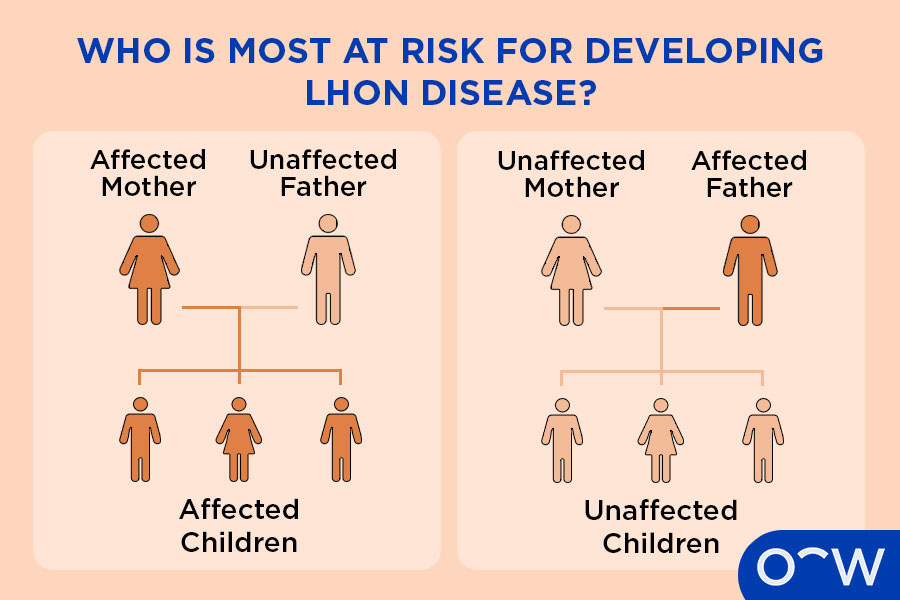
Yes, Leber Hereditary Optic Neuropathy is only inherited through the maternal line. Leber Hereditary Optic Neuropathy is a mitochondrial DNA (mtDNA) disorder, and mitochondria are only passed to children through the maternal line. A female with a primary LHON-causing mtDNA variant will transmit the variant to all of her offspring, according to Dr P. Yu-Wai-Man’s research article titled ‘Leber Hereditary Optic Neuropathy’ (1993). Both male and female children can inherit the disease, but males are significantly more likely to develop symptoms. Males are four to five times more likely to be affected than females, according to Dr P. Yu-Wai-Man.
What are the Symptoms of Leber Hereditary Optic Neuropathy?
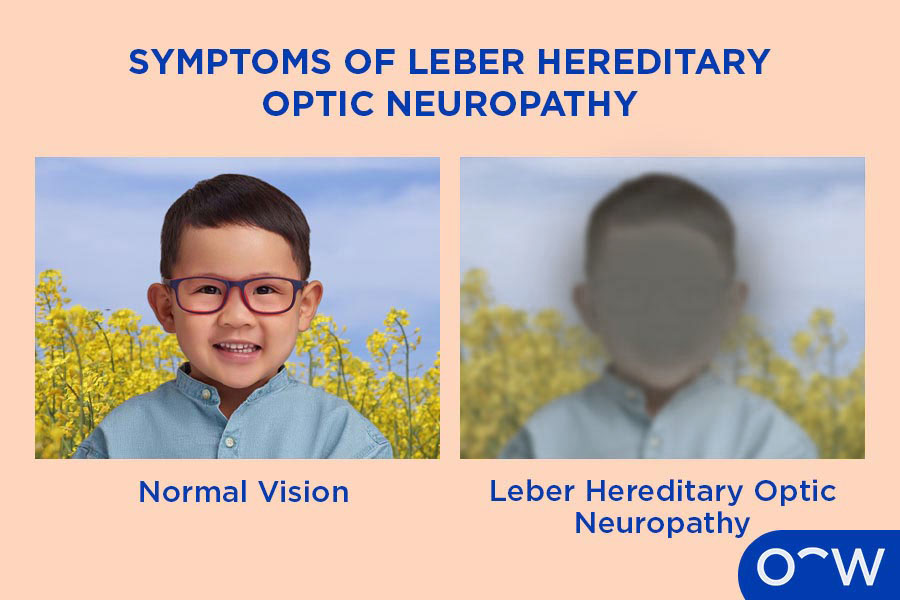
Leber Hereditary Optic Neuropathy primarily affects central vision. Symptoms of Leber Hereditary Optic Neuropathy usually start with a blurring of central vision in one eye, and affect both eyes within weeks or months. The symptoms of Leber Hereditary Optic Neuropathy include a sudden onset of blurred central vision (usually beginning in one eye), a growing central blind spot (central scotoma), colour vision loss, contrast sensitivity loss, and optic atrophy. The symptoms of Leber Hereditary Optic Neuropathy are listed below.
- Blurred central vision: Blurred central vision often appears suddenly, and vision deteriorates rapidly, leading to central vision loss. Blurred central vision usually appears in one eye first, with the second eye declining after a few weeks or months.
- Central scotoma: Central scotoma is a growing central blind spot in the visual field.
- Colour vision loss: Colour vision loss involves difficulty discriminating red and green colours early on. People with severe cases of Leber Hereditary Optic Neuropathy may experience a blue-yellow deficit later on.
- Contrast sensitivity loss: Contrast sensitivity loss refers to difficulty distinguishing an object and its details from the background.
- Atrophic phase: The atrophic phase refers to permanent damage to the optic nerve, also known as optic atrophy.
How does Vision Typically Change During the Early Stages of LHON?
The early stages of Leber Hereditary Optic Neuropathy involve central vision blurring in one eye, which progresses to the second eye within weeks or months, leading to visual impairment, colour vision deficits, and central scotomas, according to Dr A. Shemesh (2024). Central vision blurring is the first symptom of Leber Hereditary Optic Neuropathy, and involves rapid, cloudy or blurred vision affecting the central vision field, usually in one eye, then the other, according to Dr A. Stramkauskaite’s research article titled ‘Clinical Overview of Leber Hereditary Optic Neuropathy’ in 2022. Progression to the second eye can occur within a few months to a year, although it can sometimes start in both eyes. Both eyes are affected simultaneously in approximately 25% of cases, according to Dr A. Stramkauskaite.
Does LHON Cause Painless Central Vision Loss?
Yes, acute, painless loss of central vision is a main characteristic of Leber Hereditary Optic Neuropathy, according to Dr A. Stramkauskaite (2022). Loss of vision is painless, a key factor in distinguishing the disease from other eye diseases such as optic neuritis, which usually causes eye pain. Patients usually do not experience eye pain or inflammatory signs commonly seen in conditions like optic neuritis, because Leber Hereditary Optic Neuropathy is a neurodegenerative disease.
How does LHON Affect Daily Visual Function?
Leber Hereditary Optic Neuropathy causes a sudden loss of central vision, severely affecting daily activities that require clear eyesight, such as reading and writing, facial recognition, and driving. The development of central scotoma causes a blurry or blind spot in the centre of the vision field, making it particularly hard to see details straight ahead. Reading small print in books or on screens also becomes close to impossible, and patients who become legally blind will not be able to drive. General daily tasks such as recognising faces and navigating busy areas become very difficult for people with Leber Hereditary Optic Neuropathy. People with Leber Hereditary Optic Neuropathy often retain their peripheral or ‘side vision’, and this can allow them to navigate their environment independently.
How does LHON Impact Daily Activities Like Reading and Face Recognition?
Leber Hereditary Optic Neuropathy significantly affects daily activities such as reading and facial recognition due to loss of central vision. Reading can become very challenging or impossible due to loss of fine detail perception, and recognising others is affected as ‘face perception is strongly impaired’ in patients with Leber Hereditary Optic Neuropathy, according to Dr R. Francomme’s research titled ‘Visual Functions in Patients With Leber Hereditary Optic Neuropathy’ in 2024 with 12 participants. Central vision loss means that magnification and high-contrast visual aids become essential for affected individuals to regain their independence, according to Dr P. Yu-Wai-Man (1993).
Can LHON Lead to Legal Blindness?
Yes, Leber Hereditary Optic Neuropathy can commonly lead to legal blindness. Vision in people with Leber Hereditary Optic Neuropathy varies from person to person, but usually, visual acuity is around 6/60 or worse. Visual acuity refers to someone’s clarity of vision, and is often measured at a distance of 6 metres and expressed as a ratio, for example, 6/6 vision. People with Leber Hereditary Optic Neuropathy are often considered legally blind, according to the Mito Foundation. Many individuals retain their peripheral vision despite being legally blind.
Who is Most at Risk for Developing LHON Disease?
Young adult males who carry mitochondrial mutations inherited from their mother are the most at risk for developing Leber Hereditary Optic Neuropathy. Leber Hereditary Optic Neuropathy has a ‘strong male preponderance (80% to 90%), and the usual age at onset is between 15 and 35 years’, according to Dr A. Shemesh (2024). Environmental triggers such as smoking, alcohol use, and exposure to environmental toxins may also influence symptom onset.
Why are Young Adult Males More Commonly Affected by LHON Disease?
Young males are more commonly affected by Leber Hereditary Optic Neuropathy due to hormonal and genetic factors. Leber Hereditary Optic Neuropathy is passed through the maternal line, and both sexes may inherit the mutation, although males develop symptoms significantly more often. Female carriers of Leber Hereditary Optic Neuropathy are thought to be protected by estrogen and experience lower penetrance of symptoms than their male counterparts. There is also a hypothesis that there is a modifier gene on the X chromosome that works together with the mitochondrial DNA mutation, and as males only have one X chromosome, they are more likely to develop the disease.
Are Males More Likely Than Females to Develop LHON Symptoms?
Yes, males are significantly more likely to develop symptoms of Leber Hereditary Optic Neuropathy than females. Leber Hereditary Optic Neuropathy affects predominantly males in 80-90% of cases, according to Dr C. Meyerson’s research article titled ‘Leber hereditary optic neuropathy: current perspectives’ in 2015. Female carriers can carry the disease without symptoms. The exact biological reason remains under study, but current research points to the protective effects of estrogen and the X-linked susceptibility gene as two main factors for the disease manifesting significantly more in men.
How is Leber Hereditary Optic Neuropathy Diagnosed?
Leber Hereditary Optic Neuropathy is diagnosed through clinical eye tests and, most importantly, genetic testing to identify mitochondrial DNA mutations. An eye healthcare provider will perform specialised eye tests to determine your eye health and vision. They will often ask questions regarding your general health and family history of eye problems. If Leber Hereditary Optic Neuropathy is suspected, genetic testing will be needed to identify mutations in mitochondrial DNA, which involves a sample of blood or saliva being sent to a laboratory to confirm a diagnosis, according to the Centre for Eye Research Australia. There are 3 primary mtDNA mutations that testing looks for, which are responsible for the majority of cases.
What Eye Tests Detect Genetic Vision Loss Like LHON?
Several eye tests performed by eye healthcare providers can confirm Leber Hereditary Optic Neuropathy, including a combination of specialised eye tests, imaging, and genetic testing. An MRI (Magnetic Resonance Imaging) may be required to exclude other ocular causes that have similar symptoms, and an Optical Coherence Tomography (OCT) may be performed, which measures the thickness of the retinal nerve fibre layers and optic nerve, helping to detect swelling. A visual field test may also be performed, which measures peripheral and central vision to detect central scotoma, as well as a visual acuity test, which measures the severity of central vision loss. Colour vision testing is often performed, which assesses for defects in red-green and blue-yellow colour perception. These tests can suggest Leber Hereditary Optic Neuropathy, but as it is caused by mutations in mitochondrial DNA, a definitive diagnosis can only be confirmed through genetic testing.
Is Genetic Testing Required to Confirm LHON?
Yes, genetic testing is required to confirm Leber Hereditary Optic Neuropathy. Genetic testing identifies mitochondrial DNA mutations, which account for the majority of Leber Hereditary Optic Neuropathy cases. An eye healthcare provider may suspect Leber Hereditary Optic Neuropathy based on clinical signs, but these alone are not definitive, and genetic confirmation is essential.
What Triggers Can Worsen LHON Symptoms?
The triggers that can worsen Leber Hereditary Optic Neuropathy symptoms can include smoking, alcohol use, and exposure to environmental toxins. The triggers that can worsen LHON symptoms are listed below.
- Smoking: ‘Cigarette smoking is associated with either the onset or progression of Leber Hereditary Optic Neuropathy, and heavy smokers are more susceptible to the disease’, according to Dr A. Stramkauskaite (2022).
- Alcohol use: Heavy drinking often leads to an increased risk of vision loss, although its association with disease progression is not as strong as with smoking.
- Exposure to environmental toxins: Exposure to chemical solvents and industrial toxins can trigger the development of symptoms.
How Do Smoking and Alcohol Influence Disease Progression in LHON?
Smoking and alcohol influence disease progression in Leber Hereditary Optic Neuropathy through increased oxidative stress in the mitochondria. Retinal ganglion cells in the optic nerve are particularly vulnerable to mitochondrial dysfunction, which smoking and alcohol accelerate. Studies on gene-environment interactions in Leber Hereditary Optic Neuropathy, such as an Oxford Academic research article by M. A. Kirkman titled ‘Gene-environment interactions in Leber hereditary optic neuropathy’ in 2009, indicate that smoking and heavy alcohol consumption significantly increase the risk of vision loss in individuals carrying DNA mutations, particularly smokers.
Can Lifestyle Factors Increase the Risk of Vision Loss in LHON Carriers?
Yes, unhealthy lifestyle factors can significantly increase the risk of vision loss in carriers of Leber Hereditary Optic Neuropathy. The risk of vision loss is exacerbated by smoking, heavy alcohol consumption and poor nutrition. Healthy habits such as quitting smoking, moderate to no alcohol consumption, a balanced diet, avoiding environmental toxins, and monitoring eye health may help lower the risk of the disease progressing.
What Are the Treatments for LHON?
The treatments for Leber Hereditary Optic Neuropathy centre around preserving remaining vision, and no conclusive cure exists. Treatments include low vision aids, idebenone, lifestyle changes, antioxidants and supplements, and gene therapy. The treatments for Leber Hereditary Optic Neuropathy are explained below.
- Low vision aids: Low vision aids are a traditional treatment method for patients with severe vision loss, particularly young adults with preserved peripheral vision, according to Dr A. Theodorou-Kanakari’s research article titled ‘Current and Emerging Treatment Modalities for Leber’s Hereditary Optic Neuropathy: A Review of the Literature’ in 2018.
- Idebenone: Idebenone is a therapy sometimes used in the management of Leber Hereditary Optic Neuropathy. Idebenone contains antioxidant properties and acts as a ‘mitochondrial electron carrier’, which may help support cellular energy (ATP) production. Some studies suggest it may support visual function in certain patients, although outcomes can vary and treatment is typically guided by a medical specialist.
- Lifestyle changes: Lifestyle changes, including avoiding tobacco use, heavy alcohol consumption, and exposure to environmental toxins, can limit risk factors for developing Leber Hereditary Optic Neuropathy.
- Vitamins and supplements: Vitamins such as B2, B3, B12, C, and E, as well as folic acid, and other supplements such as alpha-lipoic acid, carnitine, and creatine, have been used to treat mitochondrial disorders such as Leber Hereditary Optic Neuropathy. The evidence for the benefits of vitamin and supplement use for the disease remains limited.
- Gene therapy: Gene therapy is an emerging treatment approach being studied for Leber Hereditary Optic Neuropathy. It involves the defective gene being replaced by the ‘normal wild-type gene so that the normal gene is expressed’, according to Dr A. Theodorou-Kanakari. Research into gene testing for Leber Hereditary Optic Neuropathy is ongoing, and early studies have shown favourable results in some patients, although availability and outcomes may vary.
What Low Vision Aids Are Available for LHON Patients?
Low vision aids available for Leber Hereditary Optic Neuropathy can include electronic video magnifiers, handheld/mounted magnifiers (CCTV), telescopic glasses, and smartphone apps. The low vision aid options for patients are listed below.
- Electronic video magnifiers: Electronic video magnifiers allow people to read using their remaining peripheral vision. Some examples are ZoomText and SuperNova.
- Handheld/mounted magnifiers (CCTV): Handheld/mounted magnifiers or CCTV (closed-circuit television) magnifiers are devices that magnify printed materials to display a larger image on an HD monitor.
- Telescopic glasses: Telescopic glasses act as small binoculars mounted on lenses, improving central vision.
- Smartphone apps: Smartphone apps can help improve peripheral vision and magnify text. Useful apps include Be My Eyes, Smart Magnifier, and AI apps like Seeing AI.
Can Glasses Help Manage LHON Symptoms?
Yes, glasses may help manage Leber Hereditary Optic Neuropathy symptoms by supporting remaining vision. Glasses can help correct refractive errors and improve clarity for patients experiencing Leber Hereditary Optic Neuropathy. Glasses are supportive, but they do not restore damaged optic nerve fibres or reverse the disease.
Can Prescription Glasses Improve Reading for LHON Patients?
Yes, prescription glasses can improve reading for patients with Leber Hereditary Optic Neuropathy if magnification or refractive correction is needed. Strong reading prescription glasses may enlarge print for patients. Additional low vision aids are highly effective and often required for Leber Hereditary Optic Neuropathy patients.
What Lenses Can Reduce Eye Strain for People with Vision Loss?
Specialised lenses may reduce eye strain for patients with Leber Hereditary Optic Neuropathy. Specialised lenses include FL-41 tinted lenses, precision coloured lenses, polarised lenses, and blue light lenses. The details of these lenses are explained below.
- FL-41 tinted lenses: FL-41 tinted lenses are rose-coloured lenses that filter out blue and green light, decreasing pain and discomfort for patients.
- Precision coloured lenses: Precision coloured lenses are specialised tints that can improve contrast and comfort.
- Polarised lenses: Polarised lenses reduce glare, which is ideal for Leber Hereditary Optic Neuropathy patients as they often experience extreme light sensitivity.
- Blue light lenses: Blue light lenses are designed to block blue light emitted by digital screens.
Can Progressive Lenses Help People with Central Vision Loss?
Progressive lenses generally do not help, improve, or stop central vision loss caused by Leber Hereditary Optic Neuropathy, according to the Mito Foundation. Leber Hereditary Optic Neuropathy is a genetic condition that damages the optic nerve, not a refractive error of the eye. Progressive lenses are designed to fix how the eye bends light, and they cannot correct the central blur of the eye or blindness caused by a damaged optic nerve.
What Types of Sunglasses Protect Sensitive Eyes in LHON?
Different types of sunglasses can protect individuals with sensitive eyes from Leber Hereditary Optic Neuropathy, including UV protection lenses, polarised lenses, and wraparound frames. Protective sunglasses are essential and reduce light discomfort, which is often worsened by sunlight. The types of sunglasses that may help protect sensitive eyes in LHON are listed below.
- UV-protection lenses: UV-protection lenses that provide maximum UV400 protection are essential as they block harmful UVA and UVB rays.
- Polarised lenses: Polarised lenses reduce glare, which can cause eye pain and headaches. Neutral grey, brown, and copper tints help improve visual comfort. Category 3 or 4 Lenses provide higher reduction of sunglare and are recommended for sensitive eyes.
- Wraparound frames: Wraparound frames limit light entering the eye from the top, bottom, or sides.
How can Anti-Glare Glasses Improve Vision Comfort for LHON?
Anti-glare glasses coatings may improve vision comfort for patients with Leber Hereditary Optic Neuropathy by reducing light sensitivity, reducing eye fatigue, and enhancing visual clarity. People with Leber Hereditary Optic Neuropathy often experience light sensitivity, and anti-glare coatings reduce bright light intensity. Anti-glare glasses can reduce eye fatigue and headaches as the eyes do not have to work as hard to see in a glary environment. Anti-glare glasses can also enhance contrast and clarity, making it easier to see in darker conditions.
Can Photochromic Lenses Help with Light Sensitivity in LHON?
Yes, photochromic lenses may help with light sensitivity experienced by Leber Hereditary Optic Neuropathy patients. Photochromic lenses automatically darken outdoors and remain clear indoors, which helps with glare and discomfort. Optic nerve damage cannot be treated or reversed by photochromic lenses, but they can be a helpful aid to manage symptoms and improve comfort for people with Leber Hereditary Optic Neuropathy, according to the Mito Foundation.