


 1300 164 990

Vitreous Hemorrhage: Causes, Symptoms and Treatment
Published on March 16th, 2026
A vitreous haemorrhage occurs when vessels bleed into the vitreous, which is the gel in the eye centre, according to The Retina and Macula Centre. The causes are often the presence of abnormal blood vessels or normal blood vessels that can rupture under stress or trauma. The symptoms of vitreous hemorrhages include the emergence of floaters and, in severe cases, vision loss. Read more about Vitreous Hemorrhages, such as underlying eye diseases, treatments and diagnosis. It should be noted that the medical advice in this article is general in nature and should not be a substitute for professional medical advice and consultation.
What is Vitreous Hemorrhage?
A vitreous haemorrhage is a condition where blood leaks into the vitreous humour, which is the clear gel that is between the lens and retina, according to Armadale Eye Clinic. This can cause vision issues, depending on the amount of blood leakage and its location in the affected eye.
How does Vitreous Hemorrhage Occur Inside the Vitreous Humour of the Eye?
A vitreous hemorrhage occurs inside the vitreous humour of the eye, due to a blood vessel within the retina breaking and bleeding into the vitreous cavity, according to the Terrance Eye Centre.
Does Bleeding in the Vitreous Gel Interfere With Light Reaching the Retina?
Yes, bleeding in the vitreous gel interferes with light reaching the retina. This phenomenon is referred to as a vitreous haemorrhage, which is where there is bleeding into the vitreous cavity of the eye. This is the space at the back of the eye where there is vitreous gel. Bleeding in the vitreous gel can impede the full amount of light from reaching the retina.
What Causes Vitreous Hemorrhage in the Eye?
The cause of a vitreous hemorrhage is usually due to a blood vessel within the retina breaking and bleeding into the vitreous cavity. Posterior Vitreous Detachment due to retinal tears is also a common cause. Another cause of vitreous hemorrhages is the rupture of neovascular blood vessels, such as from conditions such as diabetes.
What Underlying Eye Diseases Lead to Vitreous Hemorrhage?
The underlying eye diseases that can lead to vitreous hemorrhages are diabetic retinopathy, retinal tears and trauma. Read more about these underlying eye diseases, which lead to vitreous hemorrhage, below.
- Diabetic Retinopathy: Diabetic retinopathy occurs when blood vessels in the retina become broken or damaged. This irregular blood vessel growth and damaged vessels can lead to vitreous hemorrhages.
- Retinal Tears: Retinal tears can lead to blood coming from the retinal veins to enter the vitreous humour, which is where vitreous hemorrhages take place.
- Trauma: Trauma that is blunt or perforating can damage blood vessels and cause them to bleed into the vitreous. This trauma includes instances such as getting hit with a sports ball in the eye or making contact with a sharp stick.
- Posterior Vitreous Detachment: Posterior Vitreous Detachment is when vitreous traction on the retina causes the retinal vessel to bleed. This is a common condition that leads to vitreous hemorrhage.

Can Abnormal Blood Vessel Growth Increase the Risk of Eye Bleeding?
Yes, abnormal blood vessel growth increase is a risk of eye bleeding. Abnormal blood vessel growth is referred to as neovascularisation, which is caused by diseases such as diabetes and retinal vein occlusion, according to Northside Eye Specialists.
How does Posterior Vitreous Detachment Lead to Vitreous Hemorrhage?
Posterior Vitreous Detachment can lead to vitreous hemorrhages. Posterior Vision Detachment refers to the phenomenon where the vitreous humour separates from the retina. During this process, tractive forces may either cause small retinal blood vessels to rupture, or may create a retinal tear, either of which can lead to bleeding into the vitreous cavity, and as a result causing a vitreous hemorrhage.
What Structural Changes Occur During Posterior Vitreous Detachment?
The structural changes that occur during posterior vitreous detachment are that the vitreous, which is the transparent substance that fills the middle of the eye, detaches from the retina.
Can Separation of the Vitreous From the Retina Damage Blood Vessels?
Yes, the separation of the vitreous from the retina can damage blood vessels. While the separation of the vitreous from the retina is a regular process as a person ages, it can have potential consequences, such as retinal tear or detachment, according to the Retina Doctor.
How Can Eye Injuries Cause Vitreous Hemorrhage?
Eye injuries can cause vitreous hemorrhages as the blunt or penetrating trauma can directly rupture vessels or dislocate the retina from its base, according to Bright Sight Specialists. These eye injuries can include being hit in the eye with a sports ball or a falling tree branch.
What Types of Eye Trauma Can Lead to Bleeding in the Vitreous?
The types of eye trauma that can lead to bleeding in the vitreous include blunt eye trauma, penetrating eye trauma, and perforating eye trauma. Read more about the types of eye trauma that can lead to bleeding in the vitreous.
- Blunt Eye Trauma: Blunt eye trauma encompasses sports injuries and even physical fights.
- Penetrating Eye Trauma: Penetrating eye trauma is when the eye makes contact with sharp objects, such as sticks.
- Perforating Eye Trauma: A perforating eye trauma is defined as one where the trauma has separate entrance and exit wounds.
Can Sudden Impact to the Eye Trigger Internal Eye Bleeding?
Yes, a sudden impact to the eye can trigger internal eye bleeding. A punch, a tree branch falling, or a kick to the eye can result in internal eye bleeding.
What are the Symptoms of Vitreous Hemorrhage?
The symptoms of vitreous hemorrhage include floaters, blurry vision, dark patches in vision, light flashes and cobwebs in vision. The symptoms of vitreous hemorrhages below.
- Floaters: Floaters are small spots or threads that appear in your line of vision. They can be harmless, but in vitreous hemorrhages, they may appear more frequently.
- Blurry Vision: Blurry vision is common in vitreous hemorrhages. You may not be able to see as sharply as before having a vitreous hemorrhage.
- Dark Patches in Vision: Dark patches in your vision may emerge, blocking out parts of your line of sight.
- Light Flashes: Light flashes may appear in your vision, and you may experience more sensitivity to light.
- Cobwebs in Vision: Cobwebs in your vision refer to floating, thread-like strands resembling cobwebs, like its name suggests. It is a symptom of vitreous hemorrhages similar to floaters.
What Vision Changes Occur When Blood Enters the Vitreous Humour?
The vision changes that can occur when blood enters the vitreous include blurry vision and a reddish tint over your line of sight, according to Vision Eye Institute.
Can Dark Spots or Shadows Suddenly Appear in the Field of Vision?
Yes, dark spots or shadows can suddenly appear in the field of your vision if you suffer from a vitreous hemorrhage. It is a common symptom of the condition.
How are Eye Floaters Related to Vitreous Hemorrhage?
Eye floaters are related to vitreous hemorrhages as they are a common symptom. They are caused by vitreous debris that emerges as a result of vitreous hemorrhages, according to The Royal Australian College of General Practitioners.
Can Small Particles of Blood Create Moving Spots in Vision?
Yes, small particles of blood can create moving spots in vision as a result of vitreous hemorrhages. A vitreous haemorrhage is when blood leaks into the vitreous humour, which can lead to fresh blood cells floating to appear as dark, cloud-like floaters in your vision, according to Bright Sight Eye Specialists.
How is Vitreous Hemorrhage Diagnosed During an Eye Test?
Vitreous hemorrhage is diagnosed during an eye test through processes such as an optical coherence tomography (OCT) or a dilated fundus examination.
What Clinical Tests Help Eye Doctors Detect Vitreous Hemorrhage?
The clinical tests eye doctors may use to detect vitreous hemorrhages include a slit-lamp exam, Optical Coherence Tomography (OCT) scan and Fluorescein angiography Test. Read more about these clinical tests to detect vitreous hemorrhages below.
- Slit-lamp exam: A slit-lamp exam is used to observe and assess the vitreous haemorrhage.
- Optical coherence tomography (OCT) scan: The Optical Coherence Tomography creates high-resolution scans of the macula and retina.
- Fluorescein Angiography Test: The Fluorescein angiography test may be used in certain cases to assess the source of the hemorrhage such as vascular leakage.
Can Doctors Detect Internal Eye Bleeding during a Dilated Eye Exam?
Yes, a doctor, namely an Optometrist, can spot minute internal eye bleeding during a dilated eye test.
What Treatments are Available for Vitreous Hemorrhage?
The treatments available for vitreous hemorrhages are anti-VEGF injections, laser therapy and steroid injections. These treatment options do not treat the hemorrhage itself, rather the underlying causes of it. It is important to note that you should consult a medical professional to assess which treatment is best for you and any potential risks that can come with it. Read more about these treatments available for vitreous hemorrhages below.
- Anti-VEGF Injections: Anti-VEGF injections work by shrinking abnormal vessels, reducing leakage and reducing the risk of repeat bleeding, according to Bright Sight Eye Specialists.
- Laser Therapy: Laser therapy comes in many different forms and intends to seal leaky vessels or reseal retinal breaks.
- Steroid Injections: Steroid injections can help reduce swelling and inflammation in the eye and can be useful if macular oedema is also present, according to BrightSight.
Can Mild Cases of Vitreous Bleeding Improve with Monitoring Alone?
Yes, mild cases of vitreous bleeding can improve with monitoring alone. If a vitreous haemorrhage is mild and does not have any effects on your vision, no treatment may be required, according to Terrace Eye Centre. However, it is always important to consult an Optometrist when you experience symptoms of vitreous bleeding.
What Other Eye Conditions are Associated With Vitreous Hemorrhage?
The other eye conditions that are associated with vitreous hemorrhages include retinal tears and detachment, Posterior Vitreous Detachment, trauma, diabetic retinopathy and age-related macular degeneration (AMD). Read more about these eye conditions associated with vitreous hemorrhage below.
- Retinal Tears and Detachment: Retinal tears and detachment can lead to a vitreous haemorrhage due to blood vessels within the retina being torn.
- Posterior Vitreous Detachment: Posterior Vitreous Detachment is when the vitreous, the jelly-like substance in the middle of the eye becomes watery and less jelly-like. It begins to detach and move away from the retina at the back of the eye, and can lead to vitreous hemorrhages.
- Trauma: Trauma to the eye such as blunt or penetrative contact can lead to vitreous hemorrhages. This includes contact with fast moving sports balls, sharp sticks or other harsh objects.
- Diabetic Retinopathy: Diabetic retinopathy is a condition where blood vessels in the retina become damaged and irregular blood vessels grow. These weak blood vessels can leak into the vitreous and lead to vitreous hemorrhages.
- Age-related Macular Degeneration (AMD): A type of age-related macular degeneration called Wet Macular Degeneration is where blood vessels leak fluid or blood into the macula. Abnormal blood vessels in wet age-related macular degeneration may extend into the vitreous cavity and lead to vitreous hemorrhage.
How are Retinal Tears and Retinal Detachment Linked to Vitreous Bleeding?
Retinal tears and retinal detachment are linked to vitreous bleeding as they are common causes. A retinal tear and detachment can lead to the eye's interior bleeding, which is called a vitreous haemorrhage, according to Sydney Retina.
Can Damage to the Retina Increase the Likelihood of Vitreous Bleeding?
Yes, damage to the retina can increase the likelihood of vitreous bleeding. It is often a common cause of vitreous bleeding.
Can Corrective Lenses Improve Daily Visual Clarity for Patients Recovering from Vitreous Hemorrhage?
Corrective lenses may improve visual clarity for patients recovering from vitreous hemorrhage in everyday life, such as prescription glasses. However, they are not a remedy or treatment for vitreous hemorrhages.
How can Sunglasses Protect Eyes After Vitreous Hemorrhage?
Sunglasses can protect eyes after a vitreous hemorrhage from harsh Ultraviolet (UV) rays, a type of light emitted from the sun. However, sunglasses are not a necessary part of recovery, and do not eliminate or reduce symptoms.
Can Blue Light Glasses Improve Vision After Vitreous Hemorrhage?
There is no scientific evidence to suggest blue light glasses improve vision after a vitreous hemorrhage. Blue light glasses aim to block or reduce the blue light emitted from digital screens, according to the Cleveland Clinic. While they may be useful for digital eye strain and fatigue, they will not improve vision quality after vitreous hemorrhages.
When to See an Eye Doctor for Sudden Vitreous Hemorrhage Symptoms?
You should see an eye doctor for sudden vitreous hemorrhage symptoms if you experience severe symptoms that impede clear vision. If you experience blurry vision, or black dots or figures that resemble clouds or cobwebs in your vision, then you should seek urgent help, according to Retina Doctor Melbourne.
What Warning Signs Indicate the Need for Immediate Eye Examination For Vitreous Hemorrhage?
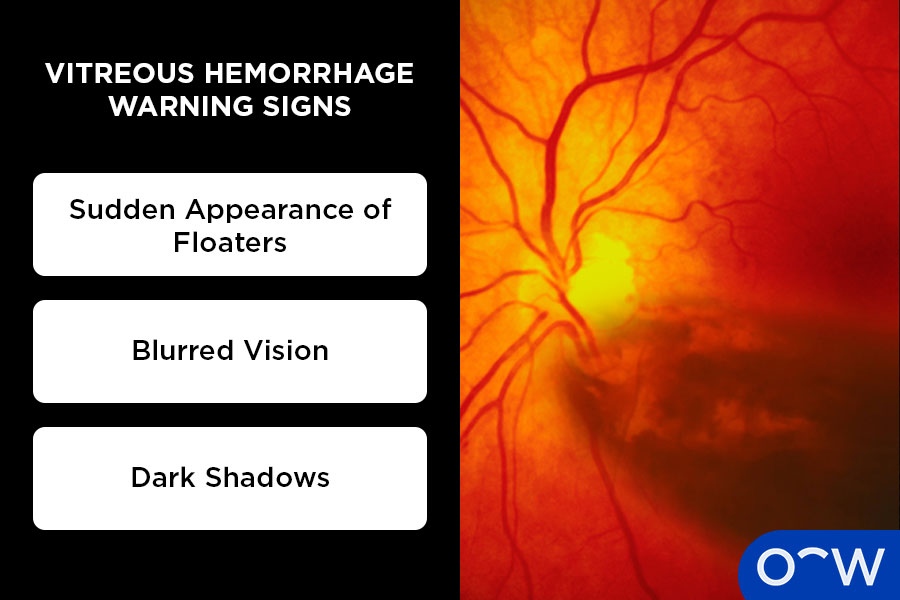
These warning signs that indicate the need for immediate eye examination for vitreous hemorrhage are the sudden appearance of floaters, blurred vision, and red tinted vision, according to Armadale Eye Clinic. Read more about these warning signs for vitreous hemorrhage below.
- Sudden Appearance of Floaters: The sudden appearance of floaters may occur more frequently. These small, moving spots and thread-like bodies may drift across the field of vision in the affected eye. They can be harmless; however, if they are frequent in your line of vision, it is important to get them checked.
- Blurred Vision: Blurred vision can make finer details harder to distinguish. Tasks like reading and computer work may be affected.
- Red Tinted Vision: You may experience red-tinted vision due to the presence of red blood cells in the vitreous humour. These can create a reddish or darker hue across part of your visual field.
Can Sudden Vision Loss or Floaters Signal a Vitreous Hemorrhage?
Yes, sudden vision loss or floaters can be a signal of a vitreous hemorrhage. However, it should be noted that these can also be signs of other eye conditions and that you should consult an optometrist if you experience these dramatic vision changes.