


 1300 164 990
Congenital Cataracts: Causes, Symptoms and Treatment
Published on October 27th, 2026
Congenital cataracts are the clouding of the eye’s natural lens present at birth or within a baby’s first year of life. The main types of congenital cataracts are nuclear, anterior polar, posterior polar, zonular (lamellar), cerulean (blue dot), and sutural cataracts. If congenital cataracts are left untreated, they can cause permanent blindness or severe, lifelong visual impairment.
Please note that Oscar Wylee offers optometry services only; this article is for educational purposes only and is not a substitute for professional medical advice, diagnosis, or treatment. If you notice a white or cloudy pupil in your baby, see your GP or hospital urgently.What Are Congenital Cataracts?
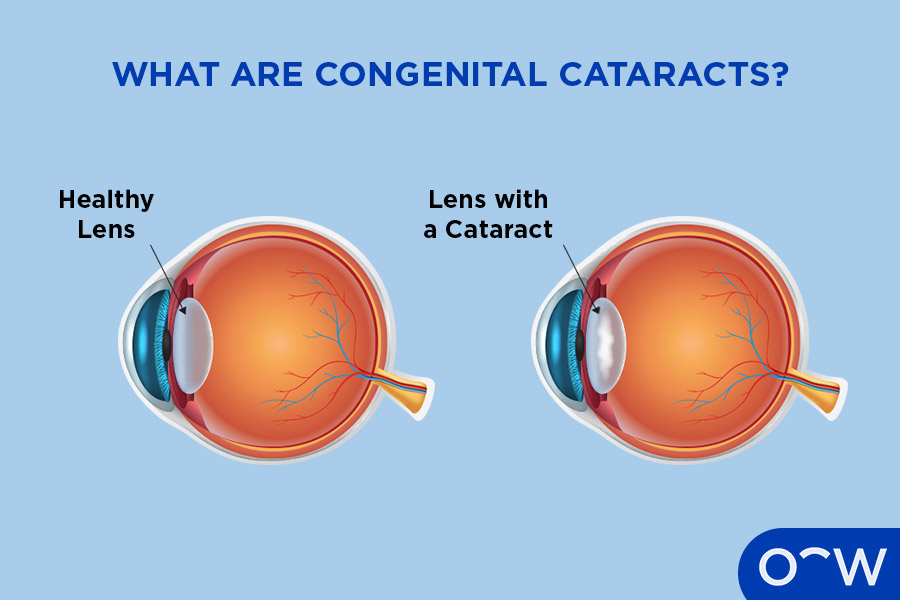
Congenital cataracts are a clouding of the eye’s lens that is present at birth or develops within the first year of life, according to The Sydney Children’s Hospitals Network (SCHN). Congenital cataracts affect 1 in 5,000 children in Australia (or about 2 to 3 out of every 10,000 babies), according to SCHN. They are treated as a medical emergency, as they can lead to permanent vision loss if left untreated.
How Do Congenital Cataracts Affect a Baby’s Vision?
Congenital cataracts affect a baby’s vision by clouding the lens, which either blocks or scatters light, preventing clear images from entering the retina, according to Cataract Kids Australia. The way cataracts affect a baby’s vision depends on their size, location, and density, but can include blurred or blocked vision, extreme glare sensitivity, visual inattention, nystagmus (involuntary, rhythmic eye movements), and strabismus (crossed eyes).
Can Babies Be Born With Cataracts in One or Both Eyes?
Yes, babies can be born with cataracts in one or both eyes, according to SCHN. Unilateral cataracts (one eye) often happen sporadically, meaning they occur without a family history of cataracts or underlying health conditions. Bilateral cataracts (both eyes) are more likely to occur due to genetic factors.
What Causes Congenital Cataracts?
The causes of congenital cataracts are genetic mutations, pregnancy-related infections, chromosomal and systemic conditions, and unknown causes. These congenital cataract causes are explained below.
- Genetic Mutations: Genetic mutations account for approximately 25% of congenital cataracts, according to the University of Tasmania. These happen when faults in the specific gene responsible for producing lens proteins occur.
- Pregnancy-Related Infections: Pregnancy-related infections such as rubella and chickenpox can cross the placenta and damage the developing baby’s eye during pregnancy, according to Vision Australia.
- Chromosomal and Systemic Conditions: Chromosomal and systemic conditions such as Down syndrome and metabolic disorders can be a cause of congenital cataracts.
- Unknown Causes: Unknown causes mean congenital cataracts can occur spontaneously and the underlying cause remains unknown, according to Cataract Kids Australia.
Are Congenital Cataracts Hereditary?
Yes, congenital cataracts can be hereditary, with around 25% having a direct genetic basis, according to the University of Tasmania. Congenital cataracts often have an autosomal dominant pattern, meaning they can be passed directly from parent to child.
Can Infections During Pregnancy Cause Congenital Cataracts?
Yes, some infections during pregnancy can cause congenital cataracts. Infections such as rubella and chickenpox can be transmitted from mother to fetus and potentially disrupt normal lens development. It is important to note that infections during pregnancy make up a small portion of overall congenital cataract cases.
What Are the Main Types of Congenital Cataracts?
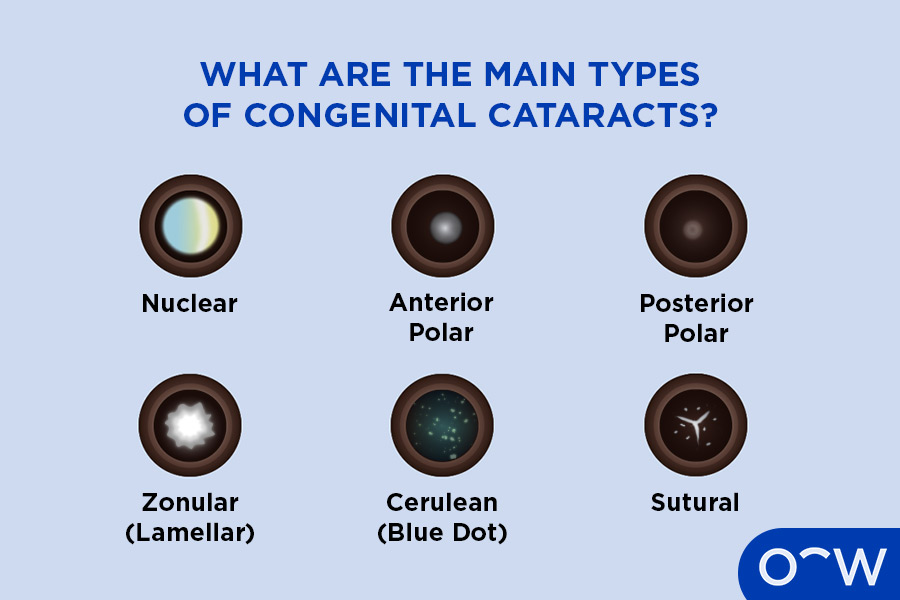
The main types of congenital cataracts are nuclear, anterior polar, posterior polar, zonular (lamellar), cerulean (blue dot), and sutural cataracts. These main types of congenital cataracts are explained below.
- Nuclear Cataracts: Nuclear cataracts are one of the most common congenital cataracts, accounting for approximately 25% of cases. Cloudiness is dense and apparent in the nucleus or centre of the lens, and the outer layers remain clear.
- Anterior Polar Cataracts: Anterior polar cataracts are small opacities at the anterior or front tip of the lens. These cataracts often do not severely affect vision.
- Posterior Polar Cataracts: Posterior polar cataracts form on the posterior or back tip of the lens.
- Zonular (Lamellar) Cataracts: In zonular (lamellar) cataracts, cloudiness forms in a specific layer of the lens fibres, and the centre and outer cortex remain clear.
- Cerulean (Blue Dot) Cataracts: Cerulean (blue dot) cataracts are tiny, bluish dots scattered throughout the lens cortex and nucleus. These cataracts are often genetic.
- Sutural Cataracts: Sutural cataracts involve cloudiness forming along the Y-shaped suture lines where the lens fibres meet during fetal development.
How Does a Congenital Nuclear Cataract Differ From Other Types?
A congenital nuclear cataract differs from other types of congenital cataracts mainly due to its specific location and higher risk of causing severe vision impairment. Nuclear cataracts form specifically in the embryonic and fetal nuclei, or the complete centre of the lens. These cataracts are very dense and block light severely, meaning babies born with them need urgent medical attention to prevent amblyopia. Children born with nuclear cataracts may be at a higher risk of microphthalmia (abnormally small eyes) and, therefore, secondary glaucoma.
Can Congenital Cataracts Affect Different Parts of the Lens?
Yes, congenital cataracts can affect different parts of the lens. For example, a nuclear cataract affects the nucleus (central core) of the lens, and anterior polar cataracts affect the anterior (front tip) of the lens. Cataract location is heavily dependent on how the lens develops in the womb.
What Are the Symptoms of Congenital Cataracts?
The main symptoms of congenital cataracts are physical signs such as leukocoria (white pupil), abnormal ‘red reflex’, strabismus (misaligned eyes), and behavioural signs such as poor visual tracking, lack of social awareness, and nystagmus (involuntary, rhythmic eye movements). These physical and behavioural symptoms are explained below.
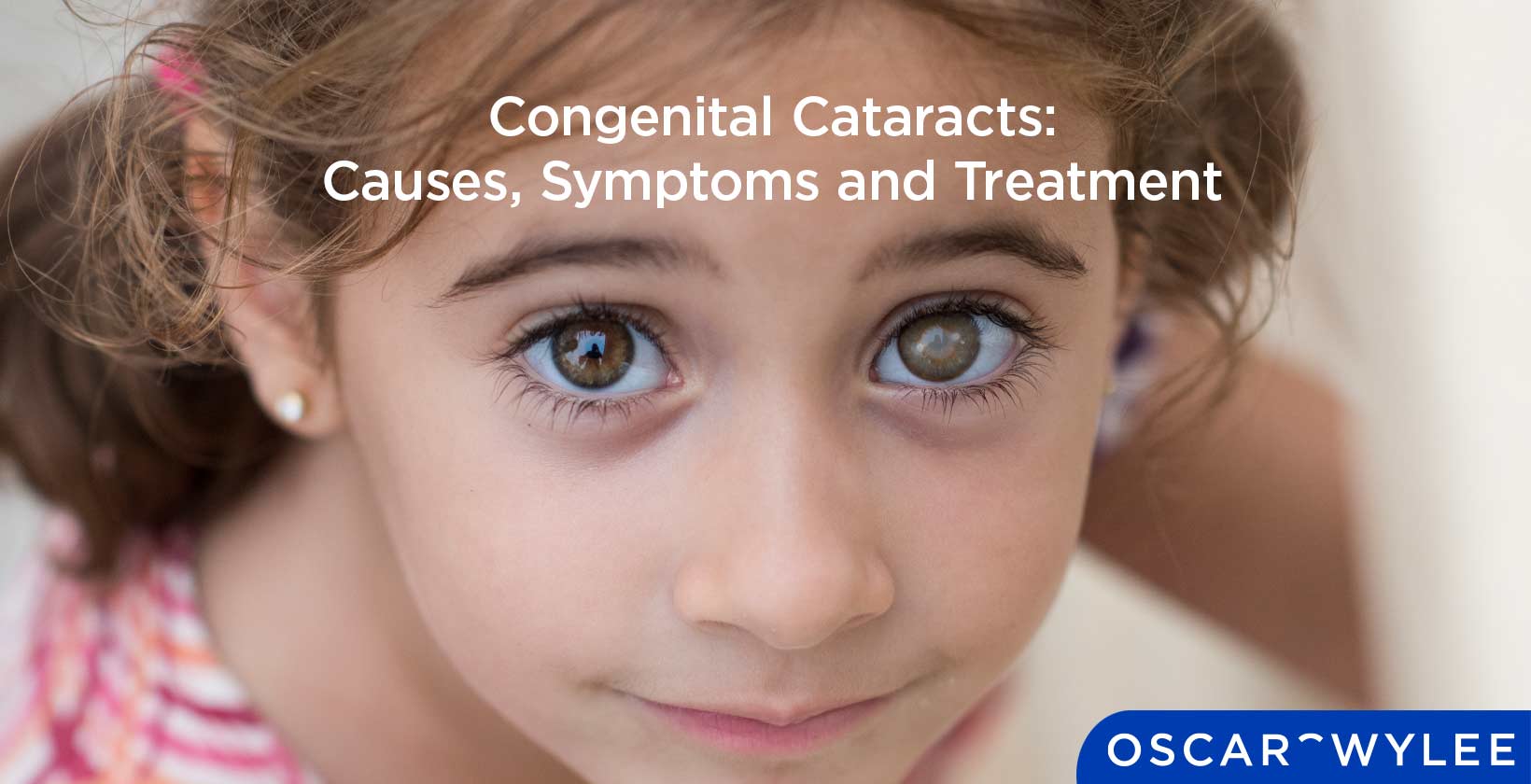
- Leukocoria (White Pupil): Leukocoria, or a white pupil, is when the pupil appears white, grey, or cloudy instead of the normal black colour.
- Abnormal ‘Red Reflex’: An abnormal red reflex test refers to a missing or abnormal reflection in flash photos.
- Strabismus (Misaligned Eyes): Strabismus refers to misaligned eyes, meaning the eyes do not align properly or appear squinted.
- Poor Visual Tracking: Poor visual tracking means a baby struggles or fails to fixate on, follow, or track moving objects or faces.
- Lack of Social Awareness: Babies may display a general lack of social awareness or not smile when looking at a parent.
- Nystagmus (Involuntary, Rhythmic Eye Movements): Nystagmus refers to rapid, involuntary wandering eye movements.
How Can Parents Recognise Cataracts in Babies?
Parents can recognise cataracts in their baby by noticing physical changes in the eye and how their baby reacts to the world around them, according to SCHN. Babies will be screened for eye issues in the hospital or during routine primary eye checks, but some issues may not be visible until later on. Key signs that parents can look for to recognise cataracts include a white or grey pupil, an abnormal ‘red reflex’ in photos, poor visual tracking, misaligned eyes, and sensitivity to light (photophobia).
How Are Congenital Cataracts Diagnosed?
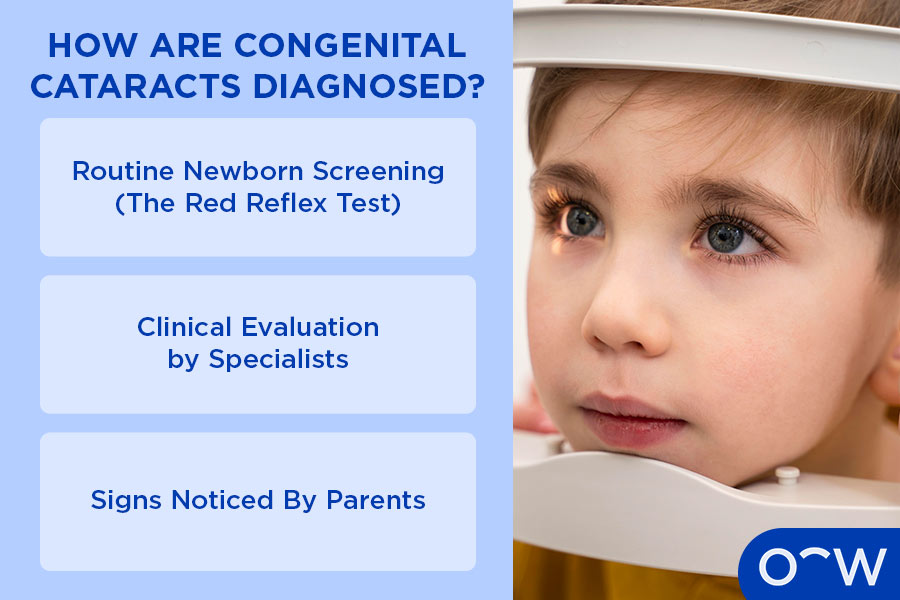
Congenital cataracts are diagnosed by routine newborn screening (the red reflex test), clinical evaluation by specialists, and signs noticed by parents. These ways congenital cataracts can be diagnosed are explained below.
- Routine Newborn Screening (The Red Reflex Test): The Red Reflex Test is a routine newborn screening test where a paediatrician or midwife shines a light on the baby’s eyes using an ophthalmoscope. They look for a red-orange reflection from the retina, similar to when a flash photo is taken.
- Clinical Evaluation by Specialists: Clinical evaluation by specialists will happen if a defect is suspected during an eye check by an optometrist or GP. The baby will be referred to a paediatric ophthalmologist (specialist eye doctor) for formal diagnosis and surgical management. An ophthalmologist will use pupil dilation and a slit-lamp and ophthalmoscope assessment to diagnose the patient. Once diagnosed, investigative testing for the underlying cause will be undertaken, including a possible family history assessment and blood and urine tests.
- Signs Noticed by Parents: Signs noticed by parents are not technically a diagnostic method, but they can help prompt diagnosis of a congenital cataract. Signs to look out for include a white or greyish pupil, poor visual tracking, and nystagmus.
Can a Newborn Eye Test Detect Congenital Cataracts?
Yes, a newborn eye test can detect congenital cataracts. The red reflex test involves a healthcare professional darkening the room and using an ophthalmoscope to shine a light into the baby’s eyes. This should cause light to reflect off the retina in a symmetrical, red-orange colour in both pupils. If a congenital cataract is blocking light, the reflex may appear dull, have dark flecks, or be completely absent.
Are Additional Tests Needed to Find the Cause?
Yes, additional tests are often needed following a newborn eye test to find the cause of congenital cataracts. The red reflex test can only detect the presence of a cloudy lens, not the underlying cause. Once an abnormality is found, an ophthalmologist will run a number of tests to look for genetic, metabolic, or infectious causes. These can include pupil dilation, an ultrasound B-scan, and family eye tests.
What are the Treatment Options for Congenital Cataracts?
The treatment options for congenital cataracts include monitoring, surgical removal, post-surgical optical correction, and patching therapy and rehabilitation. Treatment will depend heavily on factors such as the size, density, and location of the cataract, and whether it is unilateral or bilateral. The main treatment options for congenital cataracts are explained below.
- Monitoring: Monitoring involves regular and frequent tracking by a paediatric ophthalmologist in cases where the cataract is small, off-centre, or mild enough that it does not impact the child’s vision, according to the SCHN.
- Surgical Removal: Surgical removal or lensectomy is a procedure where a paediatric surgeon creates tiny incisions to suction out the affected lens. Surgical removal of a congenital cataract will take place if it is dense or the child has a risk of permanent vision loss.
- Post-Surgical Optical Correction: Post-surgical optical correction refers to custom contact lenses, glasses, or intraocular lenses (IOLs) being used to help an infant focus after surgery. IOLs (surgically implanted permanent lenses) are mostly reserved for older children and generally avoided in babies under about 1-2 years because the eye is still growing rapidly.
- Patching Therapy and Rehabilitation: Patching therapy and rehabilitation involve a patch being worn over the child’s ‘good’ eye to prevent a lazy eye (amblyopia). This usually requires strict adherence up until the age of 7 or 8.
When Does a Baby Need Cataract Surgery?
Babies with congenital cataracts affecting their vision significantly will need surgery within the first 6–10 weeks, and earlier (around 4–6 weeks) when only one eye is affected. Surgery will be vital during this age window to allow light to clearly reach the retina and prevent permanent vision loss. The factors that come into play with timing of surgery include the cataract’s severity, whether it affects one or both eyes, and evaluation by a paediatric ophthalmologist.
Can Glasses Help After Cataract Surgery?
Yes, glasses can help after congenital cataract surgery, but contact lenses are more commonly used for infants and young children due to the rapid rate the eye grows, according to Cataract Kids Australia. Glasses help the eyes focus after surgery and can be used alongside patching to treat lazy eye (amblyopia), according to Cataract Kids Australia.
What Happens if Congenital Cataracts are Left Untreated?
If congenital cataracts are left untreated, they can cause permanent blindness or severe, lifelong visual impairment, according to SCHN. Congenital cataracts left untreated in infants have more severe consequences than in adults, according to Cataract Kids Australia. Untreated, congenital cataracts can lead to neural connections failing to form in a baby, resulting in irreversible vision loss. A child can also develop issues such as strabismus and nystagmus. As untreated cataracts progress, surgery risk and complexity increase, as well as the risk of complications such as lens rupture or post-operative inflammation. Secondary glaucoma, which can lead to a damaged optic nerve, is also a possibility. Untreated congenital cataracts in babies and children can also lead to general developmental disadvantages, such as impaired motor, cognitive, language, and social development, which could consequently lead to long-term life challenges, according to Western Sydney University.
Can Untreated Cataracts Cause Amblyopia in Children?
Yes, untreated cataracts can cause amblyopia in children, specifically called form deprivation amblyopia. A cataract stops light from reaching the retina, causing the brain to ‘tune out’ input and rely on the stronger eye, causing amblyopia. During key developmental years, if the neural connection fails to develop, it can cause irreversible vision loss. Post-operative patching helps to force the brain to use the weaker eye, according to Healthdirect Australia.
Can Early Treatment Help Prevent Permanent Vision Loss?
Yes, early congenital cataract treatment is essential to prevent permanent vision loss, according to SCHN. A severe congenital cataract generally needs treatment during early infancy in order to support healthy visual development, according to Western Sydney University. However, not all cataracts need surgery, and in some cases, an ophthalmologist may choose to monitor it closely instead, according to Vision Australia.
How Do Children Recover From Congenital Cataract Treatment?
Children recovering from congenital cataract treatment will need to undergo immediate post-operative care following surgery, and many years of visual rehabilitation, according to SCHN. Congenital cataract recovery is seen as a lifelong journey; A child who has undergone congenital cataract removal requires ongoing care by a paediatric ophthalmologist. Post-operative care lasts days to weeks, starting with an eye patch or shield being placed over the eye following surgery. Children in recovery will need a strict medication schedule including topical antibiotics and anti-inflammatory steroids multiple times a day for the first month post-surgery. They will also need to refrain from strenuous activities and swimming for at least 1-2 weeks.
Visual rehabilitation helps stimulate the brain’s visual pathways. It involves specialised contact lenses for children under 2 years old, or thick glasses, according to Cataract Kids Australia. Intraocular lenses (IOLs) or artificial lenses may also be implanted during surgery for older children or delayed until the child turns 2 or 3, according to SCHN. Patching is also part of rehabilitation, where the child wears a patch over their ‘good’ eye for a certain period of time each day to prevent a lazy eye (amblyopia), according to SCHN.
Will a Child Need Long-Term Vision Care After Cataract Surgery?
Yes, a child will need long-term vision care after cataract surgery, according to Cataract Kids Australia. Children’s eyes are still growing and adapting, so long-term care is important for monitoring their vision carefully and avoiding any complications. Long-term vision care for children following cataract surgery involves visual rehabilitation and monitoring and managing long-term risks, such as aphakic glaucoma, according to Cataract Kids Australia.
Can Congenital Cataracts Return After Surgery?
No, congenital cataracts cannot return after surgery, according to Healthdirect Australia. When a congenital cataract is surgically removed, the natural lens is removed, so the cataract itself can't come back. However, patients can experience post-surgical symptoms that can feel like the symptoms of a new cataract during posterior capsule opacification (PCO). In PCO, patients can experience a gradual decline in vision, blurriness, or glare, which can feel like the cataract is returning.